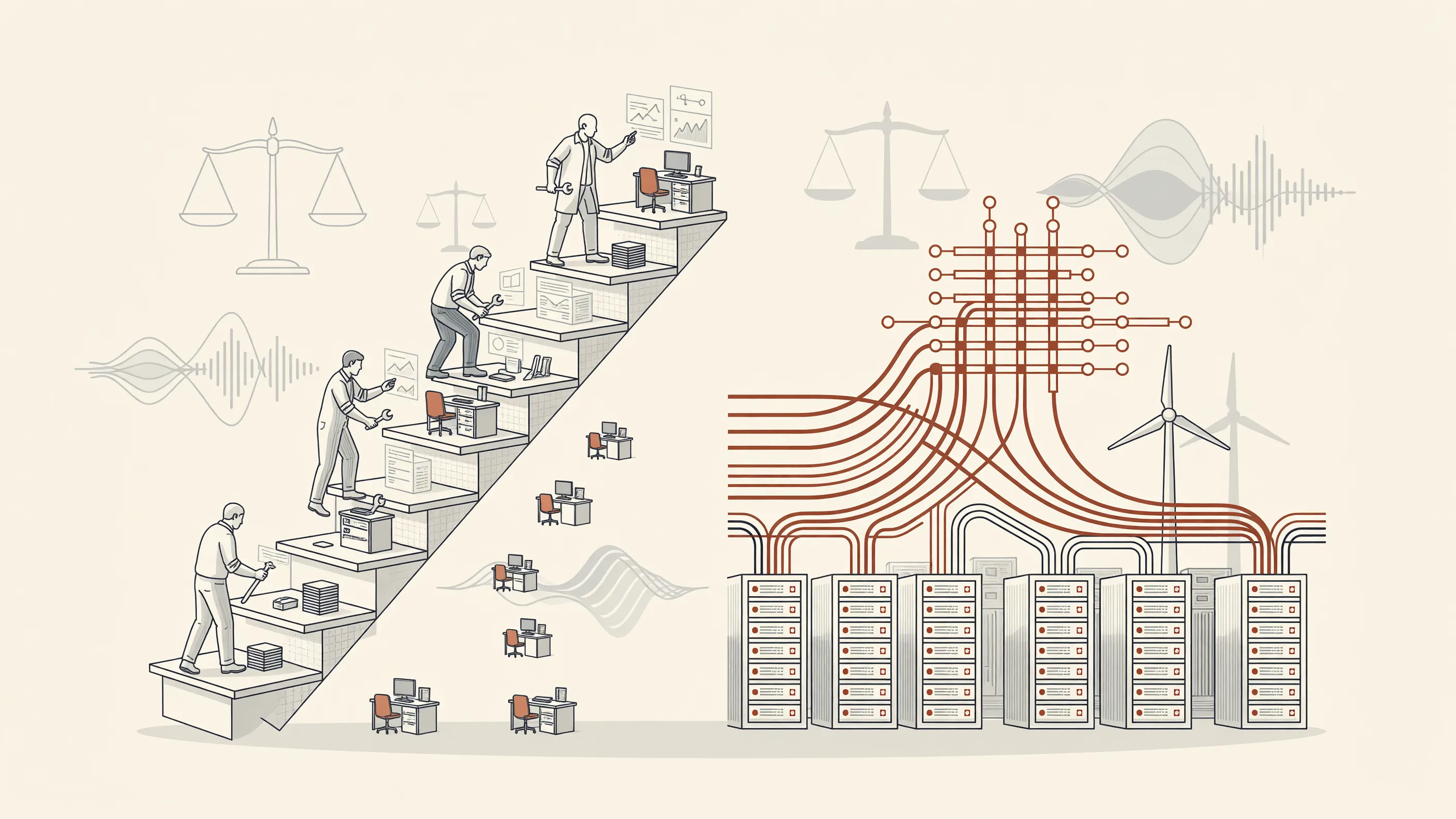
BLS projects AI and IT will grow the builders and shrink routine office support.
What happened: In a July 16, 2026 Economics Daily brief on the 2024–34 employment projections, the U.S. Bureau of Labor Statistics says wider use of information technology, including artificial intelligence and generative AI tools, will boost demand in some computer and mathematical occupations while dampening it in several office and administrative support fields. Data scientists are projected to grow 33.5% (+82,500 jobs); information security analysts 28.5% (+52,100); operations research analysts 21.5% (+24,100); computer and information research scientists 19.7% (+7,900); and software developers 15.8% (+267,700) — the largest absolute gain in the set. On the other side of the ledger, customer service representatives are projected to fall 5.5% (−153,700); legal secretaries 5.8% (−9,000); claims adjusters 5.1% (−18,200); procurement clerks 8.7% (−5,400); medical transcriptionists 4.9% (−2,200); and secretaries and administrative assistants except legal, medical, and executive 1.6% (−30,800). Total employment across all occupations is still projected to rise 3.1% (+5.2 million). BLS frames the declines as productivity gains from AI integration into workflows, not as a single natural experiment proving mass unemployment.
Why it matters: The official decade-ahead split is builders and analysts up, high-volume routine support down — while the overall job count still grows. The measurable record is whether hiring follows the occupational map, whether displacement shows up as slower hiring or layoffs, and whether training dollars move with the same occupations BLS names.
IEA’s updated AI-energy outlook: data-centre power roughly doubles to 950 TWh by 2030.
What happened: In Key Questions on Energy and AI, a follow-on to its April 2025 Energy and AI report, the International Energy Agency updates the global picture of AI’s electricity claim. Observed 2025 growth: global data-centre electricity demand rose about 17%, while AI-focused data centres surged about 50%. Major model providers reported roughly 3× active users and 5× revenue over the past year. The central outlook now sees data-centre electricity consumption roughly doubling from 485 TWh in 2025 to 950 TWh in 2030 — about 3% of global electricity demand — with AI-focused sites tripling over that window. Hyperscaler capital expenditure exceeded USD 400 billion in 2025 and is expected to jump another 75% in 2026; five tech companies’ capex now exceeds global oil-and-gas production investment. IEA satellite tracking says “AI factories” more than tripled in capacity in 18 months. Per-task efficiency is falling fast — energy use per AI task down by at least an order of magnitude annually, with simple text queries often using less electricity than running a television for the same period — but video, reasoning, and agentic tasks can use hundreds or thousands of times more energy per query. Near-term bottlenecks in grid connections, equipment, high-bandwidth memory (through at least end-2027), and capital markets reduce the chance of more aggressive near-term cases despite booming pipelines. Data-centre-associated emissions roughly double to about 350 million tonnes in 2035, still about 2% of global electricity-sector emissions.
Why it matters: This is an updated institutional consumption path, not a live meter and not the older generation-to-serve series from the 2025 report. The measurable record is whether 2025’s +17%/+50% growth holds, whether 485→950 TWh tracks reality, and whether efficiency gains outrun heavier use cases.
One advanced rack ≈ 65 households by 2027 — and onsite gas is filling grid delays.
What happened: The same IEA executive summary puts hard edges on density and stopgap power. By 2027, a single advanced server rack — about the size of a large refrigerator — could have peak power demand equal to roughly 65 households. AI-server power density rose about 11× from 2020 to 2025 and is set for a further ~4× by 2027. Because AI loads swing hard, IEA sees about 20–25 GW of batteries possibly installed in data centres globally by 2030, a potential grid asset if incentives align. Constrained by slow grid connections, U.S. developers are pushing onsite natural-gas generation; satellite tracking shows about one-fifth of those projects have started land clearing or construction. Reliable onsite gas for variable AI load requires overbuilding generation by about 30–70% relative to demand. IEA estimates roughly 15–27 GW of onsite natural gas may power data centres by 2030, mostly in the United States — and still says most sites prefer a grid connection. Separately, IEA–OECD modelling in the report puts a possible AI-driven GDP boost at +1–4% on the level of global energy demand in 2035 versus a no-AI-boost path, concentrated in knowledge services and high-income countries.
Why it matters: Density and onsite gas are the local politics of the global TWh path. The measurable record is rack power, how many onsite-gas projects clear land, whether batteries show up as grid assets, and whether communities accept gas turbines as the price of AI halls.
Twitch streamers sue Amazon over using broadcasts to train AI.
What happened: Amazon is facing a class-action lawsuit over training AI models on videos people broadcast on Twitch, the streaming platform it owns. Connecticut-based streamer Warren Pandiscia brought the case on behalf of millions of Twitch users, alleging Amazon used their videos to train AI without permission or proper compensation and breached its contract with users. The suit seeks damages and an order stopping the practice. Twitch and Amazon have not commented. Streamers reportedly produced more than 215 million hours of content in the first months of 2026 alone. The training move already drew user backlash when it was announced, with an opt-out path that Twitch says can disable “training for Generative AI” in streamer settings — though the opt-out applies to individual streams, so a creator can still be pulled into training when they appear on someone else’s enabled stream. Twitch’s chief product officer previously said he did not know whether user data had been scraped for training before the opt-out existed, and that he was unsure what Amazon had used. Twitch FAQs have said audio might refine speech-to-text models for subtitles on Twitch and Amazon video.
Why it matters: Opt-out after the fact is not the same as consent before training. The measurable record is whether courts treat live creative labor as licensable training fuel, whether opt-outs become real defaults, and whether damages or injunctions change how platforms harvest performer work.
Garton Ash: even a Hiroshima-scale AI disaster may not force real global guardrails.
What happened: In a Guardian opinion essay, historian Timothy Garton Ash writes from Silicon Valley that many experts now talk about near-term “recursive self-improvement” and the foothills of a singularity, while markets are heavily exposed to a few firms betting on a leap toward artificial general intelligence. He contrasts abundance forecasts with high extinction-risk guesses from figures such as Geoffrey Hinton, and surveys governance talk from China’s push that AI stay “under human control,” a Beijing-backed World Artificial Intelligence Cooperation Organisation aimed at the global south, and Pope Leo XIV’s encyclical Magnifica Humanitas. Citing a Chatham House argument that a major crisis may be needed to catalyse global AI coordination, Garton Ash says even that may be too optimistic: he puts the chance of “some disaster” above 90% and doubts Hiroshima-scale harm would be enough to make humankind protect itself. The piece is analysis and warning, not a new statute or enforcement action.
Why it matters: Policy failure modes are part of the public record when senior commentators argue that crisis will not automatically produce rules. The measurable record is whether national and multilateral AI regimes get binding teeth before the next incident, not after.
Nature Medicine comment: today’s medical-AI benchmarks are not a test of “superintelligence.”
What happened: A Nature Medicine Comment published 27 July 2026 — “Toward a test of medical AI superintelligence,” by Goh, Wu, Walton, Chen, Topol, Horvitz and co-authors — argues that researchers urgently need a rigorous, task-based framework to define and measure medical AI “superintelligence,” because existing benchmarks are misleading and insufficient. The public page is a Comment preview, not a patient-outcome trial and not a head-to-head tool bake-off; full text is paywalled, so no accuracy percentages or trial endpoints are locked here. Competing-interest disclosures on the page note that several authors are employees of Google, Meta, Amazon, Anthropic, OpenAI, or Microsoft, with additional consulting ties reported. The piece sits next to, rather than replaces, outcome trials and independent clinical-tool evaluations.
Why it matters: Hospitals and regulators are being sold benchmark scores as proof of clinical readiness. The measurable record is whether procurement and guidance shift from leaderboard numbers to task-based evaluation that matches real care work — and whether industry-affiliated measurement frameworks are read with that conflict in view.
UNESCO: without rights guardrails, the digital divide becomes an AI divide.
What happened: UNESCO’s rights-based education brief on AI and learners warns that generative AI and wider digitalization create real upside for access, personalization, and education management — and real risk of widening inequality. As of 2024, nearly one-third of the world, about 2.6 billion people, still lacked Internet access. Girls, rural populations, persons with disabilities, and marginalized communities are named as especially exposed if AI education tools scale on top of that baseline. The brief calls for human-centred, rights-based use of digital technology, with safeguards including strong data protection, ethical frameworks, transparent governance, inclusive access policies, and accountability mechanisms. It urges urgent national and international action so technology enhances, rather than endangers, the right to education. This is institutional framing, not a multi-country learning-outcomes trial and not a claim about measured classroom gains.
Why it matters: Education AI that ignores connectivity and disability becomes a sorting machine. The measurable record is whether national AI-in-schools policies fund access and safeguards as hard requirements, not optional polish after the tools ship.