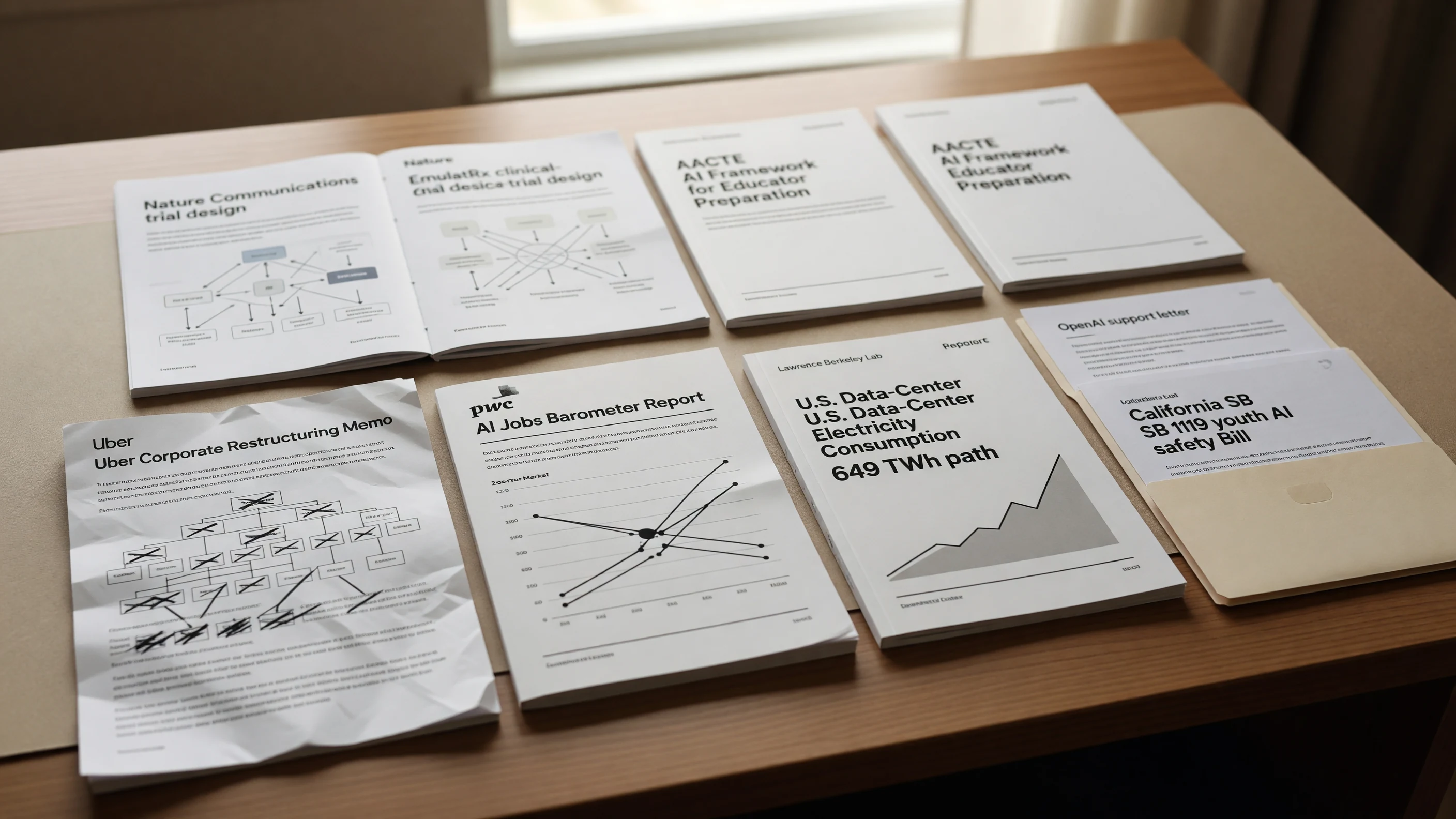
Uber cuts ~10% of staff (~3,300) to flatten layers and free capacity for an “autonomous future.”
What happened: On 2 September 2026, CEO Dara Khosrowshahi told employees Uber is reducing headcount by about 10% — about 3,300 people in contemporaneous reporting — after growth “nearly tripling” top line over five-plus years also produced more layers, coordination, and fragmented ownership. The memo’s structural moves: cut employees sitting 7+ layers from the CEO by 20%; cut “micro-teams” of only 1–2 reports by nearly 50%; combine three Delivery Ops P&Ls (Restaurants, Retail, Direct) into single-threaded teams; combine Core Services Engineering and Science; and require nearly all remote staff into offices so only about 1% remain fully remote under a three-day hybrid rule. Savings are framed for reinvestment in growth, innovation, and “the autonomous future,” not as a pure AI-task-substitution census. This is a large-platform org-chart and capital-reallocation cut — not NY Fed’s regional firm-survey layoff shares, not Census CES-WP-26-27 QWI early-career cells, and not Dallas Fed Lightcast posting declines.
Why it matters: Headcount can fall while autonomy and core product investment rise — a different labor object from shallow firm-survey adoption with rare layoffs.
LBNL 2025 update: U.S. data centers on a 649 TWh path by 2030 — about 11.8% of national electricity.
What happened: Lawrence Berkeley National Laboratory’s United States Data Center Energy Usage Report: 2025 Update (June 2026; authors include Smith, Hubbard, Newkirk, Ganeshalingam, Holecek, Sartor, Mills, Shehabi) raises the bottom-up U.S. data-center electricity path. The Reference Case is 649 TWh in 2030 — about 11.8% of total U.S. electricity — with scenario bounds of roughly 9.5–15.3%. Compounded-uncertainty bounds span about 521–843 TWh in 2030. Sensitivity cases include lower IT installations (578 TWh), more specialized graphics chips (664 TWh), shorter AI-chip lifetimes (590 TWh), and higher AI-server idle power/utilization (782 TWh). The prior 2024 report’s comparable window was about 6.7–12.0% of U.S. electricity by 2028. This is a DOE-lab bottom-up shipment/device model — not a global vendor 2026 TWh path, not RAND’s Rockport ~4.2 GW site screen, and not Ceres’ seven-state grid-water gallons.
Why it matters: National share-of-load paths answer different planning questions than single-site interconnect capacity or global vendor TWh headlines.
OpenAI urges Newsom to sign California SB 1119 — age checks, audits, and automatic teen safeguards.
What happened: On 31 August 2026, OpenAI’s Ann O’Leary publicly backed California Senate Bill 1119 and asked Governor Gavin Newsom to sign it, framing California as a standard-setter “in the absence of federal action.” The company says the bill pairs continued teen access with requirements to determine a user’s age; identify safety risks before products reach young people; undergo independent audits; protect against self-harm and sexually exploitative content; give parents guidance/limit tools; connect users to crisis-support resources; and limit targeted advertising while protecting minors’ personal information — with protections for ages 13–17 applying automatically. OpenAI ties the push to its ChatGPT for Teens defaults when the system estimates under-18 or a stated age of 13–17. This is a state companion-chatbot / youth-product statute awaiting signature — not the EU Article 50 operative transparency FAQ, not California’s already-live AI Transparency Act media marks, and not Canada’s design consultation through 23 September.
Why it matters: Once a large frontier lab endorses a state teen-safety package, the compliance surface is product design defaults and audit scope — not another countdown to an EU clock that already started.
EmulatRx: multi-agent clinical-trial design that mines EHR real-world evidence across acute and chronic diseases.
What happened:Nature Communications (7 July 2026; Li, Pan, Rajendran, Zang, Wang) introduces EmulatRx, an agentic framework that uses iterative multi-role agent conversation to extract real-world evidence from electronic health records and refine clinical-trial design (CTD) protocols into a report for human experts. Acute-disease case work uses MIMIC-IV (examples: septic shock, acute heart failure, acute pulmonary edema, acute kidney injury). Chronic-disease case work uses the INSIGHT Network across five New York City health systems (examples: Alzheimer’s and Parkinson’s). The paper positions EmulatRx against single-shot ML extractors that still need heavy iterative expert handoff. This is a multi-agent protocol-design research system — not Nature Medicine’s AITIC breast-screening triage workload/CDR trial, not LungIMPACT’s null CXR→CT pathway result, and not a marketed drug Phase III readout.
Why it matters: Trial design time and eligibility are labor bottlenecks; agent teams that draft against RWD change who holds the first protocol pen — if the audit trail stays reconstructable.
AACTE’s national AI Framework for Educator Preparation puts human judgment — not tool demos — at the center.
What happened: On 20 August 2026, the American Association of Colleges for Teacher Education released an AI Framework for Educator Preparation for educator preparation programs (EPPs). AACTE President and CEO Cheryl Holcomb-McCoy framed the duty as ensuring technology “serves, not supplants” educator expertise, ethics, and professional judgment. The framework organizes four interconnected areas: Ethical and Policy Guardrails (AI literacy, privacy, equity, accessibility, governance); Clinical Practice and Implementation (evaluating and integrating systems into teaching); Cognitive Architecture and Advocacy (metacognition, cognitive load, algorithmic bias); and Professional Expertise and Human Judgment (instructional decisions, relationships, ethical reasoning, culturally responsive practice). It treats AI literacy as professional practice rather than optional tech training. This is a national EPP professional framework — not NYC’s K–8 student generative-AI moratorium, not OECD/Commission AILit competence maps alone, and not UNICEF accessible-textbook reach counts.
Why it matters: District student bans set classroom defaults fast; educator-prep frameworks decide what future teachers are trained to refuse, audit, or adopt.
PwC 2026 AI Jobs Barometer: “professionalised” roles grow twice as fast; AI-skills wage premium hits 62%.
What happened: PwC’s 15 June 2026 Global AI Jobs Barometer (1B+ ads, six continents) reports a two-track market: “professionalised” roles (AI as force multiplier for experts) grow twice as fast in openings and show 42% faster salary growth than “democratised” roles (AI makes the job easier for non-experts). Companies most able to use AI show faster headcount growth (52% vs 36%) and higher wage growth (24% vs 17%) vs 2018 baselines; top-quintile “super-star” AI-exposed firms average 163% labour-productivity growth. Jobs needing specific AI skills grew almost 8× faster (69% vs 9% overall), with an average AI-skills wage premium of 62%. U.S. entry-level analysis (2.4M roles): AI-exposed junior openings are 7× more likely to demand traditionally senior human skills and grew 35% since 2019 while other entry-level roles fell 10%. This is a global job-ad skills/wage barometer — not Uber’s org-chart cut and not NY Fed firm surveys.
Why it matters: Wage premiums and “seniorised” junior postings can rise even while some platforms shrink middle layers.
Open deposit of the LBNL 2025 Update — same 649 TWh reference path, 521–843 TWh bounds.
What happened: The LBNL report is also deposited on escholarship as item 33m6w3x0, carrying the same Reference Case (649 TWh in 2030; about 11.8% of U.S. electricity) and compounded-uncertainty span of about 521–843 TWh (roughly 9.5–15.3%). Sensitivity cases still explore lower installations, higher specialized-graphics shipments, shorter AI-chip lifetimes, and higher AI-server idle/utilization. Treat the deposit as the open archival copy of the DOE-lab bottom-up model — not a second independent national census and not a single-site interconnect screen.
Why it matters: Planners need a citable open copy of the national share-of-load path when vendor TWh headlines and site-level GW screens disagree.
What happened: OpenAI’s public bill summary lists the core package it supports: age determination; safety-risk identification before youth availability; independent audits; protections against self-harm and sexually exploitative content; parental guidance/limit tools; crisis-support connections; limits on targeted ads and protection of young people’s personal information; automatic application for ages 13–17. The company also cites nearly nine in ten teen ChatGPT users turning to it weekly for learning, information, skill-building, or productivity — the access side of the trade-off it says the bill preserves. Do not mash this California signature clock into Article 50’s already-live EU transparency surface.
Why it matters: Compliance teams need the automatic-teen default list more than another lab statement of principles.
From acute ICU cohorts to five-system NYC chronic networks — EmulatRx’s RWD footprint.
What happened: EmulatRx’s evaluation spans ICU-scale acute conditions on MIMIC-IV and multi-system chronic neurology cohorts on INSIGHT. The architecture is multi-agent conversation plus analysis that iterates protocol refinements and ends in a design report rather than a single classifier score. Authors emphasize that prior RWE-for-CTD ML still required extensive human iteration; the agent stack is meant to carry more of that loop before experts lock eligibility and endpoints.
Why it matters: Multi-site RWD trial design only helps if phenotype definitions and exclusion logic remain inspectable when agents draft first.
Four EPP pillars: guardrails, clinical implementation, cognitive architecture, human judgment.
What happened: AACTE’s release stresses that EPPs must train future educators to evaluate AI-generated information, recognize bias and limits, protect student privacy, promote equitable access, and decide where AI fits teaching and learning. The four pillars keep instructional decisions and student relationships as educator responsibilities even when tools enter clinical practice. This is prep-program infrastructure — not a district student-use ban and not a K–12 device-minute cap.
Why it matters: Teacher-prep standards travel slower than district bans but shape the next decade of classroom AI literacy.