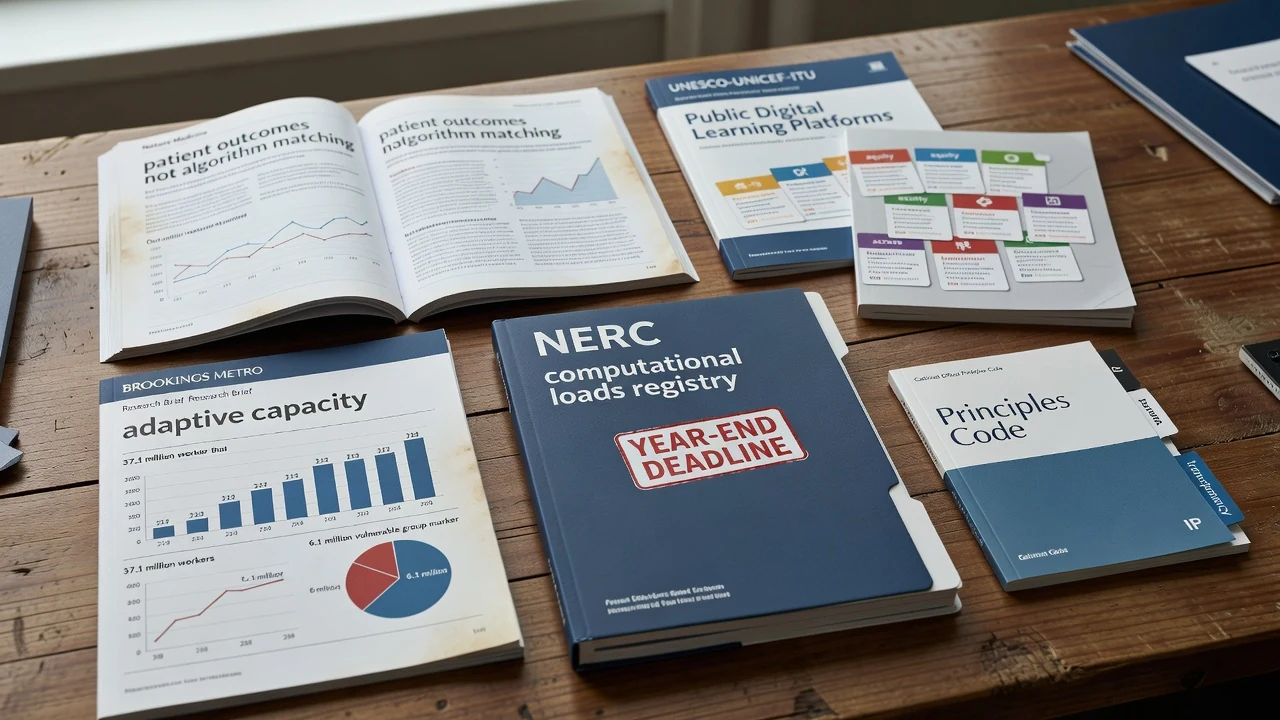
Brookings Metro: most highly AI-exposed U.S. workers have adaptive capacity — 6.1 million do not.
What happened: Brookings Metro’s Measuring US workers’ capacity to adapt to AI-driven job displacement (Manning, Aguirre, Muro, Methkupally; 21 January 2026) pairs occupational AI exposure with an adaptive-capacity index built from savings, age, labor-market density, and skill transferability, with a companion NBER paper. Of 37.1 million U.S. workers in the top quartile of occupational AI exposure, 26.5 million (~70%) also sit above the median on adaptive capacity. 6.1 million — about 4.2% of the sample workforce — face both high exposure and low adaptive capacity, concentrated in clerical and administrative roles; about 86% of that vulnerable group are women (Lightcast gender shares). Geography: high-exposure / low-capacity occupations are a larger employment share in college towns and state capitals, especially Mountain West and Midwest midsized markets. The page states explicitly that exposure measures are not predictions of job displacement; the question is who can adapt if displacement occurs. This is an adaptive-capacity welfare map — not Census CES-WP-26-25’s BTOS adoption/tasks package (18%/32%/2%), not CES-WP-26-27’s early-career QWI channel, not NY Fed’s 61%/51% regional use shares, not PwC’s job-ad barometer, not SIEPR’s unemployment synthesis, and not a 2026 layoff census.
Why it matters: The labor question shifts from “who is exposed” to “who can move” — and the residual risk is concentrated among women in clerical and administrative work.
FERC sets a year-end deadline for NERC computational-load registry criteria and standards.
What happened: NERC’s newsroom announces that FERC has set a year-end deadline for NERC to finalize registry criteria and Reliability Standards for computational loads — the bulk-power-system reliability track that decides which large AI/data-center loads must register and under what obligations. This is a who-must-register / reliability-design beat, not a TWh demand path, not a named federal campus, and not an interconnection-tariff show-cause order. No gallons, acres, operating megawatts, or emissions inventory appear in the locked title-level record used here. This is a BPS reliability registration clock — not DOE Paducah’s 1.8 / 2 / 2.6 GW campus plan, not NNSA Savannah River’s 1 GW / ~2 GW negotiation, not FERC’s six large-load show-cause orders, not IEA or Gartner electricity-path forecasts, and not a national data-center water census.
Why it matters: Grid governance for AI halls now has a second U.S. layer beside interconnection tariffs: reliability registration and standards before year-end.
Japan’s Cabinet Office posts a Principles Code for generative-AI IP protection and transparency.
What happened: Japan’s Cabinet Office released an English provisional translation of the Principles-Code for Protection of Intellectual Property … and Transparency for the Appropriate Use of Generative AI. The overview frames principles generative-AI businesses should implement for transparency and IP protection, drawing on the spirit of the Act on the Promotion of Research and Development and Practical Application of AI-Related Technologies (Act No. 53 of Reiwa 7) and on comply-or-explain corporate-governance practice. The stated aim is to balance generative-AI advancement with appropriate IP protection. This is soft-law principles guidance — not a measured drop in misinformation and not a finished labeling statute with extracted penalties. This is a Japan generative-AI IP/transparency principles code — not NIST IR 8615’s secure-hardware workshop report, not NIST AI 300-1 documentation templates, not EO 14409’s voluntary frontier access frame, not live EU Article 50 chatbot/mark/deepfake duties, and not California’s live transparency act packaging.
Why it matters: A major economy is testing comply-or-explain IP and transparency norms for generative-AI businesses outside the EU labeling model.
Nature Medicine: judge next-gen medical AI on patient outcomes of human–AI systems.
What happened:Nature Medicine published a 7 September 2026 comment by Kristina Lång (Diagnostic Radiology / Translational Medicine, Lund University, Malmö), From algorithms to patient outcomes — lessons from one of the first randomized trials of AI in medicine (DOI 10.1038/s41591-026-04633-x). The locked thesis: first-generation medical AI was judged on whether algorithms could match clinicians; the next generation should be judged on whether carefully designed human–AI systems can improve patient outcomes. Competing interests are disclosed on the page. This is a methods/thesis comment — not a new patient-outcome RCT with locked interval-cancer rates, not yesterday’s npj five-phase evaluation ladder, not MoChiAgent’s obstetric AUROCs, not ECG-CLIP, not Retina4IRD’s genotype accuracy trial, and not LungIMPACT’s null pathway study.
Why it matters: Matching a radiologist on a bench test is no longer the finish line; bedside claims need human–AI system outcomes.
UNESCO–UNICEF–ITU Charter: public digital learning platforms must stay public, inclusive, and trustworthy with AI.
What happened: UNESCO, UNICEF, and ITU launched a Charter for Public Digital Learning Platforms with seven principles: PUBLIC (public-authority governance, finance, and control; education-system sovereignty); INCLUSIVE (multilingual support; accessibility for learners with disabilities; low-cost devices; intermittent connectivity); PEDAGOGICAL (teacher-led); COMPLEMENTARY (reinforce, not replace, in-person schools and teachers); OPEN (open standards, reuse, interoperability); FOCUSED (educational needs over technological novelty); and TRUSTWORTHY (accurate, age-appropriate, safe data stewardship — and when AI or other frontier technologies are integrated, they should be tested for safety and alignment with educational objectives). The launch article frames the problem from Helsinki / International Day for Digital Learning: in many contexts for-profit firms have become de facto hosts of digital education. This is a normative public-platform charter — not a multi-country learning-outcomes RCT, not HEPI’s ~94%/12% UK undergraduate use package, not UNESCO’s U18 China MIL event, not the ICT Prize ceremony on 9 September, and not a connectivity census.
Why it matters: On the opening day of UNESCO Digital Learning Week, the bar for education AI is public control, disability-inclusive design, and safety tests against learning goals — not vendor default platforms.
Exposure is not displacement — keep the 6.1 million figure labeled as high-risk / low-capacity.
What happened: Brookings’ 6.1 million is the intersection of top-quartile exposure and below-median adaptive capacity, not jobs already lost. 37.1 million is the top-quartile exposed count; ~70% of them show above-median capacity. Do not mash with firm-reported AI employment decreases, early-career QWI drops, or unemployment syntheses from prior editions.
Why it matters: Misreading adaptive capacity as a layoff print invents a crisis the paper does not claim.
Reliability registration is not a campus megawatt print.
What happened: Keep NERC’s computational-load standards clock separate from Paducah’s 1.8 / 2 / 2.6 GW file, Savannah River’s 1 GW / ~2 GW negotiation, Virginia commercial MWh, and global electricity-path forecasts. Title-level year-end deadline only — no invented MW/kV thresholds in this edition.
Why it matters: Readers confuse who must register on the bulk power system with how many gigawatts a single site plans to build.
What happened: Japan’s Principles Code is provisional English guidance under Act No. 53 of Reiwa 7 for generative-AI IP and transparency. Keep it distinct from live EU Article 50 duties, California’s transparency act, NIST IR 8615 hardware standards, and NIST AI 300-1 comments still due 16 September.
Why it matters: Soft-law IP codes and hard transparency labels answer different enforcement questions.
Outcomes thesis beside the five-phase ladder — not a new AUROC.
What happened: Pair Lång’s patient-outcomes standard with yesterday’s npj five-phase methods ladder without collapsing them. No locked Gommers interval-cancer rates or new trial n from the paywalled body. Standing clock: WHO/ITU/WIPO GI-AI4H Hangzhou 16–18 September remains eight days out as calendar context only.
Why it matters: Evaluation frameworks and outcome standards both matter; neither is a bedside performance claim by itself.
Inclusive and Trustworthy are the AI clauses — disability, low-cost devices, safety tests.
What happened: Lock the Charter’s Inclusive (disability accessibility, low-cost devices, intermittent connectivity) and Trustworthy (AI safety and educational-alignment testing) principles as today’s education AI rule. Digital Learning Week runs 8–11 September; ICT Prize ceremony is 9 September — calendar only, not restamped survey stats.
Why it matters: Public-platform design defaults that ignore disability become structural barriers before any learning-outcomes RCT arrives.