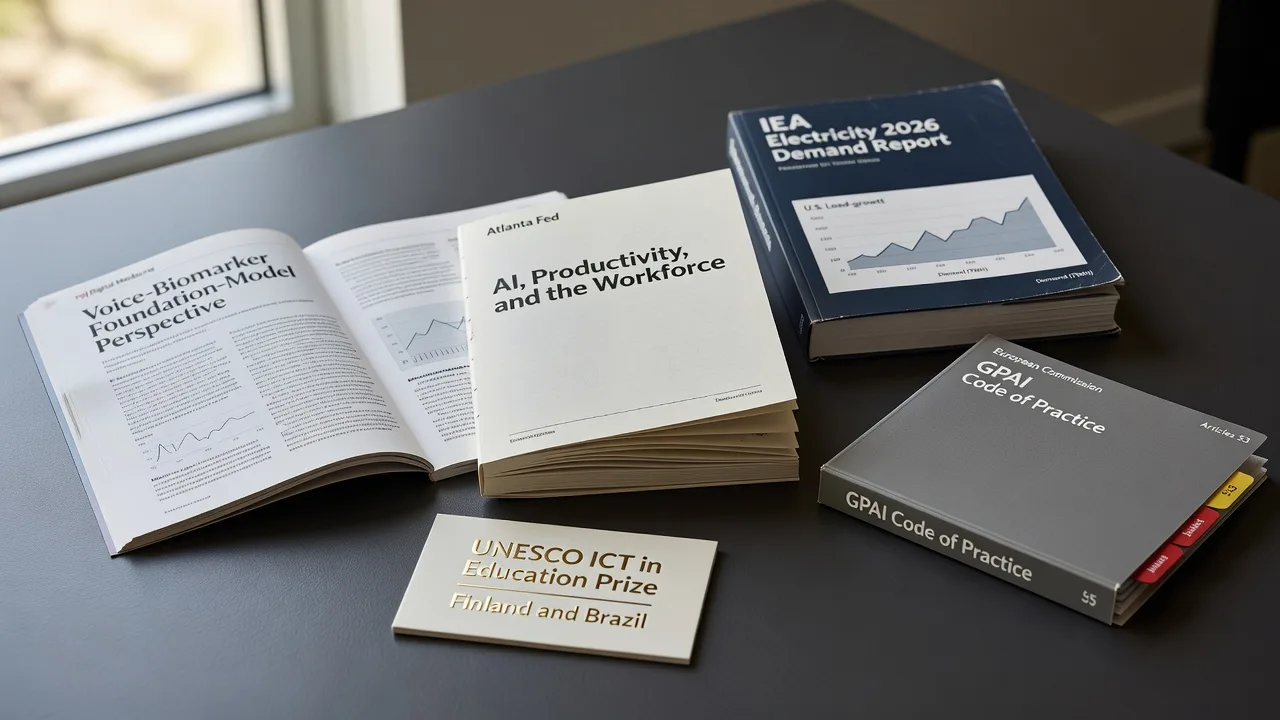
Atlanta Fed WP 2026-4: executives report little near-term aggregate AI job loss — and a clerical-to-technical shift.
What happened: Atlanta Fed Working Paper 2026-4, Artificial Intelligence, Productivity, and the Workforce: Evidence from Corporate Executives (25 March 2026; Baslandze, McClure, Meyer, Sparks, Weitz, Edwards, Waddell, Graham), uses a survey of nearly 750 corporate executives. More than half of firms have already invested in AI, though many smaller firms are only beginning. Labor productivity gains are positive, vary by sector, and are expected to strengthen in 2026, with the largest effects in high-skill services and finance; gains are framed as revenue-based TFP tied to innovation and demand, not primarily capital deepening, with a noted productivity paradox of perceived gains ahead of measured revenue. On employment, the authors find little evidence of near-term aggregate employment declines due to AI, while larger companies anticipate AI-driven workforce reductions and smaller firms expect modest gains. Compositional reallocation: routine clerical roles declining and relative demand for skilled technical roles increasing. Views are the authors’ and do not necessarily reflect Atlanta Fed, Richmond Fed, or Board policy. This is an executive-survey working paper — not Brookings Metro’s adaptive-capacity welfare map, not Census CES-WP-26-25’s BTOS adoption/tasks package, not CES-WP-26-27’s early-career QWI channel, not NY Fed regional AI-use shares, not PwC’s job-ad barometer, not SIEPR’s unemployment synthesis, and not a 2026 layoff census.
Why it matters: Firm-side executives still describe transformation and reallocation more than an aggregate employment collapse — with the cut channel concentrated in routine clerical work.
IEA Electricity 2026 Demand: U.S. data centres are about half of U.S. electricity demand growth to 2030.
What happened: IEA’s Electricity 2026 Demand chapter projects U.S. electricity use to add more than 420 TWh over the next five years, with data-centre expansion expected to make up about 50% of U.S. demand growth out to 2030. U.S. consumption is set to rise by close to 2% a year on average — more than twice the past decade — with data centres a major driver. Companion Demand-chapter context (not mashed into the U.S. growth-share): next five years add on average 50% more electricity demand per year than the past decade globally; electricity grows at least 2.5× faster than overall energy demand; advanced economies’ share of incremental global demand rose to almost 20% in 2025 (from 17% in 2024) and stays close to 20% through 2030; EU demand grows 2.3%/yr and is not expected back to its 2021 level before 2028; China accounts for nearly 50% of the global electricity-demand increase (market size), moderating to 4.9%/yr from a prior-decade 6.5%. Buildings contribute 49% of additional global demand 2025–2030. This is a U.S. growth-share electricity outlook — not IEA Energy and AI’s global data-centre TWh path, not the Key Questions global DC path, not Gartner’s global data-centre electricity forecast, not AEO2026 server electricity shares, not DOE Paducah’s named campus megawatt plan, not NNSA Savannah River’s campus negotiation, not NERC’s computational-load registry deadline, and not a water or emissions inventory.
Why it matters: The clean U.S. question is no longer only how many global data-centre TWh the world will use — it is how much of America’s own load growth AI halls claim through 2030.
EU GPAI Code of Practice: Articles 53 and 55 for model providers — voluntary, with an xAI partial sign.
What happened: The European Commission’s page on the General-Purpose AI Code of Practice frames a voluntary tool for providers of general-purpose AI models to demonstrate AI Act compliance. Three chapters: Transparency and Copyright map to Article 53 duties for all GPAI providers; Safety and Security maps to Article 55 for providers of the most advanced systemic-risk models. The Commission and AI Board have confirmed the code as an adequate voluntary tool. Named signatories on the page include Amazon, Anthropic, Google, IBM, Microsoft, Mistral AI, OpenAI, and ServiceNow, among others; xAI signed the Safety and Security chapter only and must show transparency and copyright compliance by other adequate means. A Signatory Taskforce chaired by the AI Office supports coherent application. This is a GPAI model-provider code — not live EU Article 50 chatbot / machine-readable mark / deepfake labeling duties, not Japan’s Principles Code for generative-AI IP/transparency, not NIST IR 8615, not NIST AI 300-1 documentation templates, not EO 14409’s voluntary frontier access frame, and not California’s live transparency act packaging.
Why it matters: Europe’s model-provider compliance path is now a signed code with chapter-level splits — including a public partial-sign exception — beside the separate Article 50 system-transparency clock.
npj Digital Medicine: a voice-biomarker foundation model for ALS and Parkinson’s — research agenda, not a cleared endpoint.
What happened:npj Digital Medicine published a 4 September 2026 Perspective by Loaiza-Bonilla, Arora, Hayman, Deik and colleagues, A voice-biomarker foundation model for ALS monitoring and Parkinson’s screening (DOI 10.1038/s41746-026-03206-z). The locked abstract: neurodegeneration can leave measurable acoustic traces before conventional scales change; the field remains fragmented into small, single-condition, single-language models that often fail on fully unseen speakers. The proposed next step is a clinically grounded voice-biomarker foundation model — a single self-supervised backbone pretrained on large, diverse, ethically sourced, multi-condition speech and adapted to explicit contexts of use — rather than more bespoke classifiers. ALS bulbar-progression monitoring is the lead context of use; one ALS speech-analytics platform has Breakthrough Device designation, which is neither marketing authorization nor endpoint qualification. PD screening is used as a cautionary test case on data leakage and modest real-world operating points. Explicit: to the authors’ knowledge, no speech- or voice-derived ALS/PD endpoint was qualified by FDA or EMA as of publication; the case is a research agenda, not an achieved capability. Competing interests are disclosed. This is a methods/agenda Perspective — not a patient-outcome RCT, not Lång’s Nature Medicine outcomes-of-human–AI-systems comment, not the npj five-phase evaluation ladder, not MoChiAgent’s obstetric AUROCs, not ECG-CLIP, and not a new locked diagnostic accuracy trial.
Why it matters: Voice AI for neurodegeneration is being pushed toward foundation-model science and regulatory honesty — Breakthrough status is not clearance, and no qualified speech endpoint exists yet.
UNESCO ICT Prize ceremony: two 2026 laureates from Finland and Brazil for AI creativity and critical thinking.
What happened: UNESCO’s award article reports that the 2026 ICT in Education Prize ceremony took place on 9 September 2026 during Digital Learning Week at Paris headquarters under the theme “Education in the age of AI: Facts | Frictions | Frontiers.” Two laureates — projects from Finland and Brazil — were selected from over 100 nominations by Member States and official partner organizations, judged by an independent international jury of digital-technology-in-education experts. The 2026 edition aimed to surface practices showing how teachers and learners engage AI systems in ways that encourage critical thinking, creativity, and imagination, against a framing of cognitive offloading in which learners outsource reasoning and judgment to fluent AI systems. This is a same-day prize-ceremony beat — not yesterday’s UNESCO–UNICEF–ITU Charter seven principles, not HEPI’s ~94%/12% UK undergraduate use package, not UNESCO’s U18 China MIL event, and not a multi-country learning-outcomes RCT. Project-level reach statistics are not locked from this page.
Why it matters: On ceremony day, the education AI prize is framed as reclaiming creative and critical judgment — not celebrating faster homework automation.
Little aggregate loss is not “no reallocation” — keep clerical vs technical separate.
What happened: Lock the Atlanta Fed package as n≈750 executives; more than half invested; little near-term aggregate employment decline; large-firm cuts vs small-firm modest gains; routine clerical down and skilled technical up. Do not convert the compositional shift into a national layoff rate, and do not mash with Brookings’ high-exposure / low-capacity residual or CES firm-survey adoption shares.
Why it matters: Aggregate stability can hide the same clerical channel that adaptive-capacity maps flag as least able to move.
What happened: Keep IEA Demand’s U.S. >420 TWh five-year add and data centres as ~50% of U.S. demand growth to 2030 separate from Energy and AI’s global DC path, Gartner’s global DC forecast, AEO2026 server shares, Paducah/Savannah River campus megawatts, and NERC’s who-must-register standards clock. China’s nearly 50% figure is share of global electricity-demand increase, not the U.S. data-centre growth-share.
Why it matters: Mixing growth-shares with global TWh paths invents a single “AI electricity number” the Demand chapter does not print.
What happened: GPAI Code Transparency and Copyright → Article 53; Safety and Security → Article 55 systemic-risk models only. Voluntary tool with named hyperscaler signatories and an xAI Safety-and-Security-only exception. Keep separate from live Article 50 chatbot/mark/deepfake duties (day 38 calendar context only), Japan Principles Code, and NIST AI 300-1 comments still due 16 September.
Why it matters: Model-provider documentation codes and system-level transparency labels answer different compliance questions.
Foundation-model agenda beside outcomes thesis — still not a qualified endpoint.
What happened: Pair the voice-biomarker foundation-model Perspective with yesterday’s Lång patient-outcomes standard and the npj five-phase ladder without collapsing them. Breakthrough Device ≠ marketing authorization; no FDA/EMA-qualified speech endpoint as of publication. Standing clock: WHO/ITU/WIPO GI-AI4H Hangzhou 16–18 September remains seven days out as calendar context only.
Why it matters: Research agendas and outcome standards both matter; neither is a bedside clearance claim by itself.
Ceremony day locks Finland and Brazil — not a restamped student-use survey.
What happened: Two 2026 ICT Prize laureates from Finland and Brazil; over 100 nominations; independent jury; Digital Learning Week theme “Facts | Frictions | Frontiers.” Do not invent project-level learner counts from other UNESCO pages, and do not restamp HEPI ~94%/12% or yesterday’s Charter Inclusive/Trustworthy principles as today’s primary.
Why it matters: The prize frame is critical thinking against cognitive offloading — a different education-AI story than platform governance charters or usage polls.
Positive labor productivity gains expected to strengthen in 2026; largest in high-skill services and finance; revenue-TFP, not mainly capital deepening.