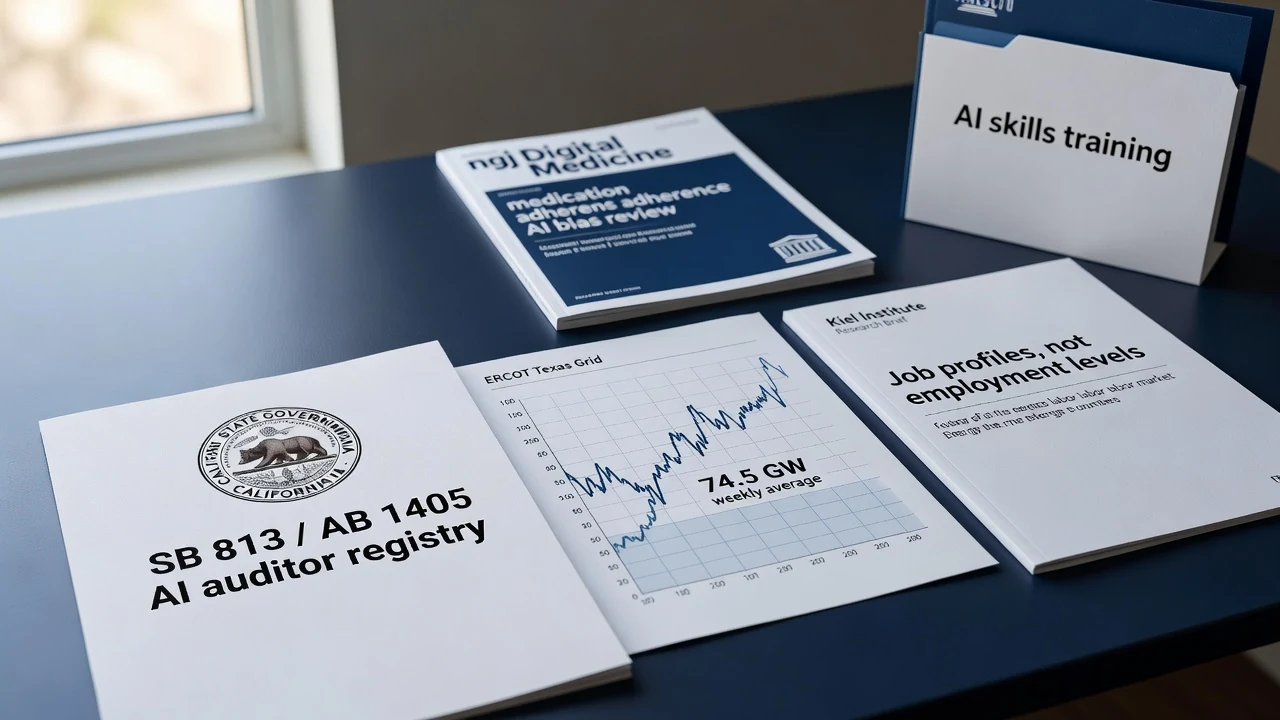
Kiel Institute: AI is transforming job profiles — not overall employment levels — in Denmark, Portugal, and Sweden.
What happened: The Kiel Institute published a news recap of Kiel Policy Brief 198, AI is transforming job profiles – not employment, based on employer–employee data from Denmark, Portugal, and Sweden covering 2010–2023. Locked claims on the page: overall AI progress over the last decade has had little to no impact on overall employment levels; exposure is not the same as jobs at risk. Language-modelling and reading-comprehension AI are associated with positive employment effects across occupations, especially production workers and managers, with hiring expanding and required skills rising; knowledge-intensive firms raise the share of highly skilled employees as they adopt AI. Translation and text-editing AI show negative effects for middle-skill (and to a lesser extent high-skill) administrative and office occupations — clerical, assistance, and call centers. Image-recognition AI is also negative, particularly for clerical and administrative roles. Most exposed occupations named: data analysts, software developers, and translators (highly cognitive, low social interaction). Least exposed: construction workers and nursing staff (physical or interpersonal). Manual production and crafts are barely affected and, if anything, positive, with profiles changing via process monitoring and machine operation. Görg’s locked line: higher AI exposure has no measurable effect on overall employment but systematically increases demand for higher qualifications. This is a European microdata / policy-brief recap — not yesterday’s ILO empirical GenAI synthesis (limited displacement; few-per-cent hours not yet in pay), not Richmond Fed EB 26-27, not Atlanta Fed WP 2026-4, not Brookings Metro’s adaptive-capacity residual, not Census CES-WP-26-25/27, not NY Fed firm-use shares, and not a 2026 U.S. layoff census.
Why it matters: The print is reallocation inside the job mix — language AI lifting demand and skills, translation and image AI pressuring clerical profiles — without a measurable aggregate employment collapse.
ERCOT aims to finish Texas’s data-center interconnection audit by December 10 — Batch Zero stays paused until verification lands.
What happened: Utility Dive reported that the Electric Reliability Council of Texas told the Public Utility Commission of Texas it intends to audit hundreds of data-center proposals by December 10, a required step before the state’s Batch Zero large-load study can continue and before new large-load interconnections resume. The pause follows Gov. Greg Abbott’s August 3 call for a moratorium on new data-center interconnections until questions on energy, water, and public funds are answered. Locked figures from the open-meeting coverage: about 300 data centers of 75 MW or larger are navigating Batch Zero; ERCOT will also run a community-impact review on data centers and crypto facilities of 25 MW and above. Abbott’s letter cited interconnection-queue requests totaling about 474 GW, with approximately 90 percent data centers — more than five times ERCOT’s record peak demand, with experts warning a substantial share may be speculative or duplicative. Chad Seely said RFIs to provisionally qualified Batch Zero loads were expected from late August into early September, with possible additional rounds in October and November, aiming at a December 10 filing and a comprehensive verification report to the PUCT a week before that month’s open meeting. Seely also said the Batch Zero interconnection study will not be done by the prior April 9, 2027 marker while ERCOT still works a new timeline. Medium-load snapshot: about 157 medium data-center and crypto facilities representing almost 8,800 MW in an April baseline now being updated with utilities. Separately, 17 large loads (mostly data centers) have cleared stability assessment and are scheduled toward energization later this year with total peak demand about 6.6 GW ramping over about five years — still subject to verification/audit and community-impact RFIs before energization approval. This is a grid-operator audit and queue-governance story — not a U.S. national generation-record monthly, not a Texas near-term load-growth forecast cut, not a global electricity mid-year demand-growth monthly, and not a campus megawatt groundbreaking.
Why it matters: Texas is not just forecasting AI load — it is freezing new large-load gates until an audit can separate real projects from a multi-hundred-GW speculative queue.
California signs SB 813 and AB 1405: first-in-the-nation independent AI verification organizations plus a state AI-auditor registry.
What happened: On 9 September 2026, Governor Newsom signed a pair of AI-safeguard bills framed as first-in-the-nation third-party audit infrastructure. SB 813 (Sen. Jerry McNerney) creates a framework for independent verification organizations that can assess AI systems and models for compliance with state law. AB 1405 (Asm. Rebecca Bauer-Kahan) creates a state registry for AI auditors and sets standards for independence, transparency, and integrity — locked governor-page line: industry should not “grade its own homework.” Together the bills push independent third-party evaluation as AI embeds in critical sectors; the Governor also calls for federal national regulation. Historical context on the same page (prior law, not new 9 September duties): 2025 SB 53 frontier transparency; child AI-companion protections; ADMT privacy rules; 2026 procurement EO; Tech Fraud Task Force; August AI Cyber Defense Program — those are background, not new signing-day requirements. Implementation years from secondary coverage are not locked here. This is a signing announcement for audit/registry infrastructure — not California’s live AI Transparency Act (CAITA) provenance/detection duties, not live EU Article 50 chatbot/mark/deepfake labels (day 41 calendar only), not the AI Omnibus Annex III / Annex I clocks, not GPAI Code Articles 53/55, and not NIST AI 300-1 documentation comments due 16 September.
Why it matters: California is building who may audit AI — independent verifiers and a public auditor registry — a different compliance question from transparency marks already live under CAITA and Article 50.
npj Digital Medicine: most medication-adherence AI models fail development-quality and bias checks before clinical readiness.
What happened: Cowdy, McPherson, da Silva, and Luo published AI models for medication adherence prediction: closing the gap to clinical readiness in npj Digital Medicine (published 2 September 2026; DOI 10.1038/s41746-026-03018-1). The systematic review covers 41 adherence-prediction modelling studies assessed with PROBAST + AI across participants/data, predictors, outcomes, and analyses. Locked findings: 71% of models showed great concern for development quality; 80% had high risk of bias in evaluation — commonly poorly defined adherence outcomes, inadequate missing-data handling, and limited validation. Reported discrimination did not consistently improve with more complex algorithms; methodological rigour, rather than model type, is the key barrier to translation. Accepted 6 July 2026; open access early version subject to further edits; no competing interests; no study funding. This is a methods and bias review — not a patient-outcome RCT, not a new AUROC claim, not Lång’s patient-outcomes comment, not the five-phase bedside ladder, not the voice-biomarker Perspective, and not yesterday’s WeatherNext Cyclones weather evaluation.
Why it matters: Before adherence models reach the bedside, the binding constraint is study design and bias control — not algorithm complexity.
UNESCO: Ghana scales AI and digital skills across TVET — toward ~140 institutions and up to 1 million learners by end-2027.
What happened: UNESCO reported that Ghana is scaling AI EmpowerED (UNESCO Global Skills Academy) with the Ghana TVET Service and GETFund, building on a 2025 AAMUSTED pilot. AI EmpowerED launched in 2025 across six countries. Locked program figures: more than 30 master trainers and around 3,300 learners have completed journeys and earned Microsoft certifications in AI and digital skills. Phase two targets around 140 TVET institutions across four consecutive three-month regional cycles, aiming to train and certify up to one million TVET educators and learners by end of 2027. Train-the-trainer path: master trainers complete an intensive bootcamp and Microsoft-accredited pathways, then share with colleagues and learners; ethical use is named on the page. Equity line locked: digital transformation must reach deprived and underserved communities where connectivity remains a challenge, including every TVET teacher regardless of location. Other scale-ups named: India, Kenya, Malaysia, Uganda, and the United Republic of Tanzania. Framed against SDG 4 and SDG 8. This is a program self-report plus 2027 aim — not UNESCO ICT Prize 2026 laureate reach, not Estonia’s AI Leap expansion package, not HEPI’s UK undergraduate survey, not NYC K–8 bans, and not a multi-country learning-outcomes RCT.
Why it matters: An African TVET system is moving from a few thousand certified learners toward a multi-campus, million-learner certification aim while naming connectivity as the equity constraint.
Profiles and skills upgraded — headcount not collapsed.
What happened: Keep Kiel locked as little/no aggregate employment effect across DK/PT/SE 2010–2023; language-AI positive; translation/image negative for clerical; systematic demand for higher qualifications. Do not convert the brief into a U.S. layoff rate, and keep it separate from yesterday’s ILO limited-displacement / few-per-cent-hours synthesis.
Why it matters: The European microdata story is occupational recomposition and skill upgrading, not a single employment-level crash.
What happened: Lock the December 10 audit target, about 300 Batch Zero sites at or above 75 MW, community-impact review from 25 MW, queue about 474 GW with about 90 percent data centers, medium-load baseline about 157 facilities / almost 8,800 MW, and 17 advanced large loads at about 6.6 GW still awaiting energization gates. Keep this separate from national generation-record monthlies and global demand-growth monthlies.
Why it matters: The near-term Texas print is verification capacity and queue hygiene — not a single AI electricity path number.
What happened: Lock SB 813 independent verification organizations and AB 1405 state AI-auditor registry with independence/transparency/integrity standards. Day-41 Article 50 and live CAITA remain standing calendar/context only — not re-fetched leads. NIST AI 300-1 comments still due 16 September (4 days).
Why it matters: Who may audit AI is a different compliance surface from machine-readable marks and chatbot notices already in force elsewhere.
What happened: Lock 41 studies; 71% development-quality concern; 80% high evaluation risk of bias; complexity did not reliably improve discrimination. Early open-access version may still edit. Standing clock only: WHO/ITU/WIPO GI-AI4H Hangzhou remains 16–18 September.
Why it matters: Clinical-readiness claims for adherence models still have to clear methods and validation bars before bedside use.
What happened: Lock more than 30 master trainers / about 3,300 certified learners; phase two about 140 institutions; up to 1 million by end-2027; connectivity named for underserved communities. Microsoft certification is a pathway metric, not exam-score evidence. Standing context only: Digital Learning Week ended 11 September.
Why it matters: Scale and equity intent are real program facts; learning-outcome proof is still a later question.
About 300 data centers at or above 75 MW in Batch Zero; queue requests about 474 GW with about 90 percent data centers; community-impact review from 25 MW.
Abbott moratorium since August 3; prior April 9, 2027 study date no longer holds.
Utility DiveSeptember 12 · Medium and advanced loads
April medium-load snapshot about 157 facilities / almost 8,800 MW; 17 advanced large loads about 6.6 GW peak over about five years still need audit gates before energization.