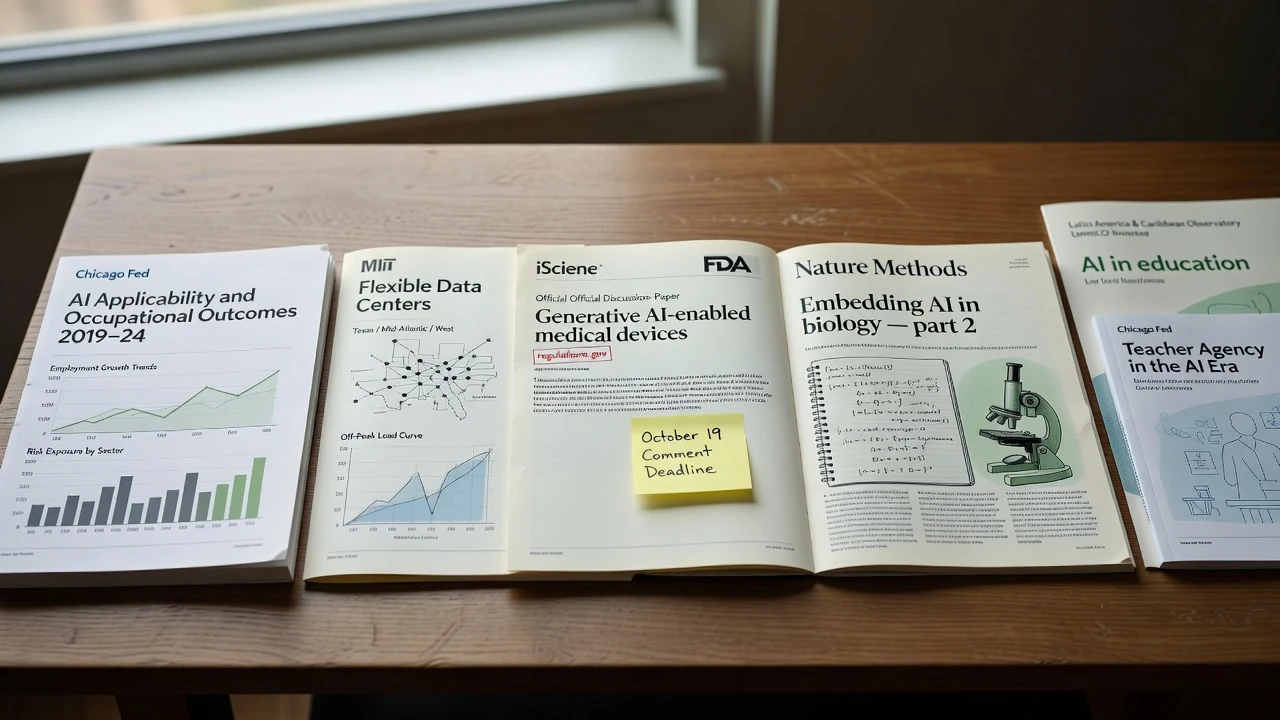
Chicago Fed WP 2026-12: high AI-applicability occupations grew jobs and pay in 2019–24 — high computerization-risk roles saw weaker employment.
What happened: The Federal Reserve Bank of Chicago published Working Paper 2026-12, Rethinking Automation Risk: AI Applicability and Occupational Outcomes, 2019–24. The paper matches Frey and Osborne’s (2017) occupational computerization-risk scores and Tomlinson et al. (2025) AI-applicability scores from Microsoft Copilot usage to O*NET classifications and BLS employment and wage data for 2019 through 2024. Locked abstract results: occupations with high AI applicability experienced overall employment and wage growth over the window; occupations with high and moderate automation-risk scores experienced weaker employment performance than low-risk occupations; wages increased across all automation-risk groupings. The authors first note that robotics, large language models, and generative AI have narrowed Frey–Osborne engineering bottlenecks in perception and manipulation, creative intelligence, and social intelligence. Locked interpretation: exposure to AI and automation does not map mechanically onto job loss, at least in the short run; task-based exposure is better read as an indicator of occupational restructuring than as a direct forecast of employment decline. Working papers are unedited; views are the authors’ and do not necessarily reflect the Chicago Fed or the Federal Reserve System. This is a U.S. ex-post occupational working-paper abstract — not yesterday’s Kiel Policy Brief 198 profiles-not-headcount recap for Denmark/Portugal/Sweden, not the ILO empirical GenAI limited-displacement synthesis, not Richmond Fed EB 26-27, not Atlanta Fed WP 2026-4, not Brookings Metro residual capacity, not Census CES-WP-26-25/27, not NY Fed firm-use shares, and not a 2026 layoff census. No employment or wage growth percentages appear on the landing-page abstract and are not invented here.
Why it matters: The short-run U.S. print separates Copilot-applicable occupations that grew in headcount and pay from older computerization-risk scores that lined up with weaker employment — exposure still reads as restructuring, not a mechanical jobs crash.
MIT / iScience: flexible data-center loads can cut regional power-system costs — but emissions effects flip by grid mix.
What happened: MIT News covered a new iScience paper, Flexible Data Centers Reduce Power System Costs But Can Increase Emissions, by Juan Ramon L. Senga, Shen Wang, and Christopher Knittel (MIT Center for Energy and Environmental Policy Research / MIT Sloan). Using the Gen X U.S. power-grid model for a full year of energy use, the study compares flexible versus inflexible data-center consumption in Texas, the Mid-Atlantic, and the Western Interconnect (the eleven large western lower-48 states) — regions that collectively host most U.S. data centers (about 82 percent by 2030 in one cited analysis). Locked cost results versus inflexible operation: flexible arrangements produce power-system cost savings of up to 5 percent in Texas, 4 percent in the Mid-Atlantic, and 2 percent in the western states; overall modeled savings are described in the 2–7 percent range. To unlock those savings, data centers would need to shift more than 20 percent of consumption — sometimes closer to 50 percent — into non-peak hours (often from early-morning and early-evening peaks toward midday solar-rich periods). Context locked on the page: about 60 percent of grid expenses are fixed costs and about 40 percent are energy costs, so higher average volume can dilute fixed costs if peak does not rise as fast; many centers run near 80 percent capacity, leaving room for load shifting; AI training loads tend to be steadier and more shiftable than inference loads tied to end-user demand. Emissions side (versus a no-data-center-growth counterfactual): modeled CO2 rises by 58 percent in Texas, 20 percent in the Mid-Atlantic, and 24 percent in the West under projected 2030-scale growth. Flexibility is not automatically clean: in high-wind Texas (about 54 percent wind in the modeled mix), flexible timing can cut CO2 by about 40 percent relative to the inflexible path by pulling more wind; in the Mid-Atlantic, flexibility can raise system CO2 by about 3 percent when load shifts keep coal online. Policy lever named: connect-and-manage — faster interconnection in exchange for time-of-use flexibility. This is a modeled flexibility / cost / emissions study — not a U.S. bottom-up national electricity path for data centers, not an IEA global Demand or Energy-and-AI electricity series, not EIA’s September STEO generation-record monthly, not yesterday’s ERCOT Batch Zero interconnection-audit timeline, and not a campus megawatt groundbreaking.
Why it matters: The near-term environmental print is not only how many megawatts arrive — it is whether AI loads can move off peak, and which regional fuel mix that movement reinforces.
FDA opens a discussion paper on regulating generative AI-enabled medical devices — comments due 19 October 2026.
What happened: On 18 August 2026, the U.S. Food and Drug Administration issued a discussion paper on considerations for regulating generative AI-enabled medical devices and opened docket FDA-2026-N-7874 for public feedback through 19 October 2026. The Digital Health Center of Excellence inside CDRH leads the paper. Locked framing: GenAI-enabled devices may introduce unique risks compared with traditional software and other AI-enabled devices. The paper outlines a possible two-axis risk-assessment framework; a premarket path built on competency assessment inspired at a high level by physician training — non-clinical benchmarking plus clinical confirmation; risk-proportionate postmarket monitoring; and considerations for foundation models and agentic AI systems. For each area the FDA poses targeted questions. Locked landing-page limits: the document is a discussion paper only; it does not represent draft or final guidance; it is not intended to propose or implement policy changes or to communicate CDRH’s regulatory expectations, including supporting-evidence expectations for future submissions; and it is not a determination of existing versus new legal authorities. Comments are invited from manufacturers, clinicians, consumers, researchers, and the public. This is a U.S. request-for-feedback on GenAI devices — not the UK MHRA National Commission staged “L-plate” advice, not live EU Article 50 chatbot/mark/deepfake duties (day 42 calendar only), not California’s SB 813 / AB 1405 auditor-registry signing package, not the AI Omnibus Annex clocks, not GPAI Code Articles 53/55, and not NIST AI 300-1 documentation comments still due 16 September (3 days).
Why it matters: The FDA is asking how to evaluate GenAI medical devices — competency tests, postmarket monitoring, foundation and agentic systems — while stating clearly that this paper is not yet guidance or a new rule.
Nature Methods: “Embedding AI in biology — part 2” — standards, benchmarks, and experimental data still set the ceiling.
What happened:Nature Methods published the editorial Embedding AI in biology — part 2 (published 4 September 2026; volume 23, page 1659; DOI 10.1038/s41592-026-03234-3). Two years after the journal’s August 2024 special issue on advanced AI in biology, the editors say AI has already infiltrated nearly every field they cover — and is changing the scientific method and scientific publishing itself. This issue gathers expert pieces on mass-spectrometry proteomics (sequence, interactions, spatial proteomics, perturbation studies, multi-omics, and more ambitious virtual-cell aims), computer vision for super-resolution microscopy (denoising, low-light, deblurring), stem-cell image analysis and generative augmentation, “virtual embryos,” instrument command and metadata so experiment-conducting AI can learn lab practice, and LLM-generated laboratory software (including a MOSS segmentation example). Locked caution lines: foundation-model benchmarking gaps remain; community standards for performance, reusability, reproducibility, and sustainability matter; rigorous methodology papers with transparent, trustworthy validation against state-of-the-art methods are essential because new methods are only as useful as they are transparent and trustworthy; and AI is nothing without high-quality experimental data — data generation, repositories, and methods that raise data quality and throughput stay central. This is a methods-journal standards editorial — not a patient-outcome RCT, not an AUROC claim, not yesterday’s npj medication-adherence bias review (41 studies / development-quality and evaluation risk-of-bias shares), not Lång’s patient-outcomes comment, not the five-phase bedside ladder, and not a new device clearance.
Why it matters: Biology’s AI wave is real across proteomics, imaging, and lab automation — but the binding constraints named here are community evaluation standards and experimental data quality, not model novelty alone.
UNESCO: Latin America and the Caribbean get a UN-anchored Observatory on AI in education — foundational learning first, not faster adoption.
What happened: UNESCO announced the Observatory on Artificial Intelligence in Education for Latin America and the Caribbean. Locked regional learning-crisis context on the page (not presented as an AI result): more than half of third-grade children do not understand what they read, and seven out of ten sixth-grade students do not master basic mathematics. Frame locked: AI has already arrived in schools; the live question is whether systems have teacher training, clear guidance, protection for vulnerable students, and evidence — without those, “technology advances and inequality deepens.” Teachers are placed at the centre, citing the International Task Force on Teachers for Education 2030 position paper Promoting and Protecting Teacher Agency in the Age of Artificial Intelligence (2025): empathy, ethical judgement, interpersonal connection, and reading a classroom cannot be automated; uncritical use can deprofessionalize teachers. Observatory design locked: first UN-system-anchored regional platform for this agenda in LAC; lines of action include regional evidence and reports, ethical and regulatory frameworks, teacher and policymaker training, links to national observatories and labs, and pilots. Purpose locked: not to accelerate technological adoption, but to make adoption — when it occurs — informed, ethical, and relevant, with foundational learning as an enabling condition for equity in the AI era. This is a regional governance / platform launch plus learning-crisis context — not UNESCO’s Ghana TVET million-learner scale-up aim, not ICT Prize 2026 laureate reach, not Estonia’s AI Leap package, not HEPI’s UK undergraduate survey, not NYC K–8 bans, and not a multi-country learning-outcomes RCT. Secondary “87 percent / 26 percent” survey figures are not on this page and are not locked.
Why it matters: A UN-anchored regional platform is trying to put teacher agency and foundational learning ahead of adoption speed while LAC still faces a deep primary-learning gap.
What happened: Keep Chicago Fed locked as high AI-applicability employment and wage growth versus high/moderate computerization-risk weaker employment across 2019–2024; wages up in every risk group; exposure as restructuring. Do not invent growth rates absent from the abstract, and keep the paper separate from yesterday’s Kiel DK/PT/SE profiles-not-headcount brief.
Why it matters: The U.S. working-paper story is differential occupational outcomes under two exposure lenses — not a single national displacement rate.
Flexibility cuts costs; emissions depend on the mix.
What happened: Lock up to 5 / 4 / 2 percent regional cost savings under flexible versus inflexible loads; more than 20 percent (sometimes near 50 percent) shifted off peak; CO2 growth 58 / 20 / 24 percent versus no DC expansion; Texas flexibility can cut CO2 about 40 percent relative to inflexible; Mid-Atlantic flexibility can raise CO2 about 3 percent; connect-and-manage as the named interconnection bargain. Keep this separate from TWh path forecasts and yesterday’s ERCOT audit timeline.
Why it matters: Grid policy for AI load is as much about when power is drawn as about how many megawatts are requested.
What happened: Lock two-axis risk framing, competency-style premarket evaluation, postmarket monitoring, foundation/agentic considerations, docket FDA-2026-N-7874, and comments through 19 October 2026. Day-42 Article 50 and NIST AI 300-1 comments due 16 September remain standing calendar only — not re-fetched leads.
Why it matters: The live U.S. device question is how to evaluate GenAI tools before any new rule text lands.
What happened: Lock the part-2 editorial’s scope across proteomics, microscopy vision, stem-cell imaging, virtual embryos, instrument metadata for experiment-conducting AI, and lab software — plus foundation-model evaluation gaps and the line that AI is nothing without high-quality experimental data. Standing clock only: WHO/ITU/WIPO GI-AI4H Hangzhou remains 16–18 September.
Why it matters: Clinical and lab translation still hinges on transparent benchmarks and real experiments, not another unvalidated demo.
What happened: Lock more than half of third-graders not understanding reading and seven of ten sixth-graders missing basic math as context; first UN-anchored LAC AI-in-education platform; teacher agency; purpose is conditions for informed use, not adoption speed. Standing context only: Digital Learning Week ended 11 September; UNESCO global education-AI consultation comments still due 15 October.
Why it matters: Regional governance capacity is the beat — measured learning gains remain a later question.
Versus no DC growth: CO2 +58 percent Texas, +20 percent Mid-Atlantic, +24 percent West; Texas flexibility can cut CO2 about 40 percent relative to inflexible; Mid-Atlantic flexibility can raise CO2 about 3 percent.
Connect-and-manage named as faster hookup for time-of-use flexibility.
FDA discussion paper on generative AI-enabled medical devices: two-axis risk, competency-style premarket path, postmarket monitoring, foundation/agentic questions.
Discussion only — not draft or final guidance; not MHRA L-plates; not SB 813/AB 1405.
Foundation-model benchmarking gaps; new methods only as useful as they are transparent and trustworthy; AI is nothing without high-quality experimental data.
Community evaluation and repositories remain central.
First UN-system-anchored regional AI-in-education platform for Latin America and the Caribbean; purpose is informed, ethical adoption conditions — not acceleration.
UNESCO platform launch — not Ghana TVET scale-up; not ICT Prize laureates.
More than half of third-graders do not understand reading; seven of ten sixth-graders miss basic math — learning-crisis context, not an AI outcome metric.
Teacher agency paper (2025) centered; empathy and classroom judgment cannot be automated.