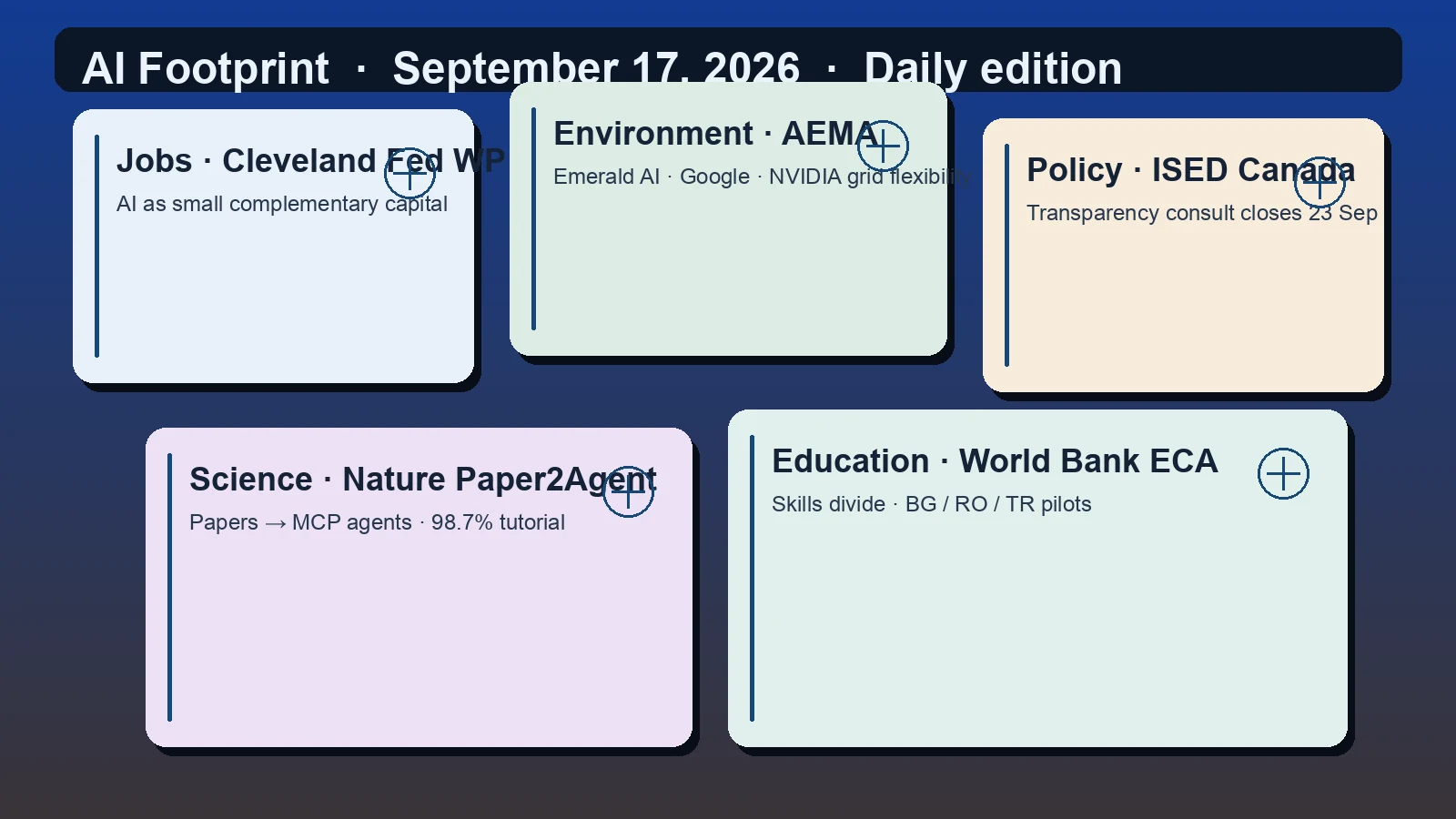
Cleveland Fed model: AI still looks like a small complement to skilled labor and equipment — not a broad replacement shock.
What happened: The Federal Reserve Bank of Cleveland published working paper 26-22, AI-Augmented Capital-Skill Complementarity (authors Luduvice and Pinheiro; DOI 10.26509/frbc-wp-202622; page date 4 September 2026). The paper models AI as its own capital input inside a nested CES production function in the spirit of Krusell et al. (2000), then embeds that structure in a dynamic general equilibrium economy. From the HTML abstract: bringing the model to the data, the authors find AI is complementary to the high-skill–equipment composite, and the AI weight in production remains small. Shock results on the same page: a rise in the AI usage share is contractionary because it increases reliance on a scarce complementary input; a fall in AI prices is expansionary because cheaper AI capital is easier to accumulate; a tax on AI capital income raises only limited revenue while the AI capital stock is small, but can finance welfare-improving transfers as the AI price falls; a large-scale UBI funded by a consumption tax slows AI investment, with welfare gains for low-skill workers and losses for high-skill workers and entrepreneurs. Measurement note on the page: a quality-adjusted AI price index from hedonic regressions and a corresponding AI capital stock. This is a regional Fed working-paper / model result — preliminary materials for discussion, not official FOMC policy, not yesterday’s Kansas City Fed industry-contribution Economic Bulletin (~2.5 vs 1.2 pp; ~64% value-added threshold), not St. Louis Fed occupation-and-task adoption, not Dallas Fed Lightcast posting declines, not Chicago Fed AI-applicability working paper, not Kiel profiles-not-headcount, not ILO limited-displacement synthesis, and not a 2026 layoff or job-creation census. No employment-level print is claimed on the extracted page.
Why it matters: After a stretch of adoption surveys and industry contribution curves, the jobs beat is aggregate production-function complementarity — AI still looks small and complementary to skilled equipment work, and raising the AI share without cheaper AI capital is contractionary in this model.
Emerald AI, Google, and NVIDIA launch AEMA — a coalition for data centers that flex power with the grid.
What happened: On 17 September 2026 coverage window, Emerald AI, Google, and NVIDIA announced the AI Energy Management Alliance (AEMA) via NVIDIA’s corporate blog, with a parallel membership home at aema.ai. Framing on the NVIDIA page: a first-of-its-kind coalition for data centers that can dynamically manage electricity use in response to grid conditions — shifting computing workloads, discharging storage, using paired generation, or responding to system contingencies so a large customer can act as a controllable resource rather than an inflexible load. Stated aims: unlock faster and larger connections for AI infrastructure; get more watts from existing infrastructure; reduce environmental impacts per watt; support energy affordability; and build AI infrastructure that works with the grid, not only on it. Design principles locked from the page: technology-neutral and performance-based requirements focused on measurable service (response speed, duration, predictability, emergency behavior); define ride-through, curtailment, and contingency-response obligations before a facility connects; standardize technical requirements, performance metrics, and operational data sharing; create faster, risk-adjusted pathways for credible and verifiable flexibility commitments; allocate interconnection costs to reflect actual system impacts and benefits such as avoided upgrades. Scope locked: convene AI platforms, infrastructure providers, data-center operators, technology companies, power producers, utilities, and regional grid operators. The page points to prior NVIDIA–Emerald AI work on flexible AI factories as grid assets and invites membership via aema.ai. This is an industry coalition / flexibility-standards launch — not yesterday’s NLR Agora national-lab large-load test bed, not IEA Electricity 2026 Grids queue chapter, not LBNL’s national-lab TWh path, not DOE draft Needs Study congestion-hours print, not ERCOT Batch Zero audit or queue megawatt prints, and not a metered 2026 campus kWh census. No independent TWh or GW inventory is locked from the extracted NVIDIA page.
Why it matters: After a week of queues, audits, and lab test beds, the environment beat is whether large AI loads can be written into interconnection rules as verifiable flexible demand — a market-and-standards layer, not another load forecast.
Canada’s ISED AI-transparency consultation is open through 23 September — five areas, including agents and serious incidents.
What happened: Innovation, Science and Economic Development Canada (ISED) is running Have your say on advancing AI transparency in Canada, open 23 July–23 September 2026 and tied on-page to Canada’s National Artificial Intelligence Strategy: AI for All. Five consultation areas on the page: (1) detecting and identifying AI-generated content; (2) knowing when one is interacting with an AI system; (3) consistent, understandable information about AI systems (development, capabilities, limitations); (4) tracking serious incidents related to AI systems; (5) better tracking the activity and interactions of AI agents. Next step on the page: government will review submissions and publish a What We Heard report; depending on volume, AI tools may be used to process feedback; submissions treated as public. Discussion paper named on-page: Enhancing trust in artificial intelligence through increased transparency. With six days left on the clock as of this edition, this is a federal design consultation plus comment window — not a statute, not yesterday’s NIST AI 200-2 TEVV-Athlon draft (comments still due 6 October), not NIST AI 300-1 (comments closed 16 September), not NIST SP 800-239, not live EU Article 50 chatbot/mark duties (day 46 calendar only), not FTC personalized-pricing comments (still due 25 September), and not a measured drop in misinformation.
Why it matters: The policy beat is how a G7 government is framing transparency duties for synthetic content, chatbot notice, system information, serious incidents, and agent activity — a live design window, not finished law.
Nature’s Paper2Agent turns research papers into interactive AI agents — higher tool accuracy than coding against the raw repo.
What happened:Nature published Reimagining research papers as interactive and reliable AI agents (Paper2Agent; DOI 10.1038/s41586-026-11044-y). The framework converts a paper plus codebase into a remote Model Context Protocol (MCP) server of tools, resources, and prompts, then wraps that server as a paper-specific agent. Tools are validated against reference outputs and locked to reduce “code hallucination.” AlphaGenome case on the page: about 22 MCP tools, all passed automated validation, built in roughly 45 minutes for about US $14 with no human intervention. Tutorial-derived queries across five runs: about 99 percent accuracy versus Claude+Repo about 83 percent and Biomni about 37 percent (15 queries). Novel queries: full marks across the reported runs versus about 79 percent and about 56 percent. Open-ended researcher-style queries: about 83 percent versus about 57 percent and about 72 percent. Scale on the page: 100 computational-biology papers yielded 74 agentified papers; 599 proposed tools, 593 passed validation. On 300 tutorial-derived questions, Paper2Agent reached about 91 percent versus Claude Code + repo about 80 percent. This is a methods-accessibility / reproducibility paper — not yesterday’s Nature Medicine on-premise clinical-agent simulation, not I3LUNG, and not a prospective patient-outcome RCT. Residual note on the page: a GWAS-locus example can disagree with the original paper’s causal-gene emphasis and is treated as re-evaluation, not a clinical result. Standing calendar only: WHO GI-AI4H Hangzhou 16–18 September is day 2 of 3.
Why it matters: The science beat is whether published methods can become reliable interactive agents instead of passive PDFs — a reproducibility tooling result, not a hospital go-live.
World Bank on Europe and Central Asia: the AI education bottleneck is skills, not tool access.
What happened: The World Bank’s Education for Global Development blog published The AI skills divide in Europe and Central Asia: Who benefits and who gets left behind, drawing on first-set Education AI Readiness Assessment work in Bulgaria, Romania, and Türkiye. Core claim on the page: the future of AI in education will be shaped less by access to tools than by whether systems build the skills to use them critically. Named examples: Türkiye’s EBA Student Assistant plus AI Teacher Assistant translation support for over one million school-age Syrian refugee children; Bulgaria’s Ucha.se platform with over 27,000 curriculum-aligned lessons and BgGPT, described as the first large-scale generative model trained entirely on Bulgarian; Romania’s SARO exam assistant, with homework-completion rates up 28%. Teacher capacity on the page: Bulgaria — over 70 percent of teachers aware of AI tools, around half have experimented; Türkiye — over 157,000 educators trained via ÖBA; Romania — nearly 83,000 teachers reskilled (nearly half the active teaching workforce) via NRRP “Digital Pedagogy.” Warning on the page: tools arrive faster than skills; urban/rural and socioeconomic gaps persist; national exams rarely test the higher-order skills AI use demands; the authors call for rigorous evaluation before national rollouts. This is a blog plus country-example package — not yesterday’s UNICEF Board “From Promise to Proof” session / Education Strategy 2026 landing, not World Bank EdTech Policy Academy (Seoul), not UNESCO AI4EAC, not PISA 2025 (still not used after access failures), and not a multi-country learning-outcomes RCT. No independent dateline is locked on the extracted page.
Why it matters: The education beat is the skills bottleneck under real national pilots — translation support, local-language models, teacher training, and one exam-assistant homework lift — not another strategy landing page.
Complementarity in a DGE model is not a layoff print.
What happened: Keep Cleveland Fed WP 26-22 as complementary-to-high-skill-equipment; small AI weight; usage-share shock contractionary; cheaper AI capital expansionary; limited AI-capital-income tax revenue while the stock is small. Keep separate from yesterday’s Kansas City Fed industry contribution bulletin and from St. Louis / Dallas adoption and posting prints.
Why it matters: Aggregate production-function complementarity is a different evidence class than industry contribution curves, occupation adoption surveys, or firm posting declines.
What happened: Keep AEMA as Emerald AI / Google / NVIDIA founding launch; dynamic electricity management; controllable-resource framing; technology-neutral performance metrics; pre-connection ride-through and curtailment rules; cost allocation tied to system impacts. Keep separate from NLR Agora, IEA Grids queues, LBNL TWh paths, and ERCOT Batch Zero audit figures.
Why it matters: Grid policy for AI load now includes voluntary industry standards for verifiable flexibility — not only national electricity-share forecasts.
What happened: Keep ISED’s five areas, including serious incidents and AI-agent activity tracking; open through 23 September 2026; nested under AI for All; What We Heard next step. Day-46 Article 50, NIST AI 200-2 still due 6 October, NIST AI 300-1 closed yesterday, and FTC personalized pricing still due 25 September remain standing calendar only.
What happened: Keep Paper2Agent AlphaGenome tutorial accuracy about 99 percent vs Claude+Repo about 83 percent; 74 of 100 papers agentified; 593 of 599 tools validated; about 91 percent on 300 questions. Standing clock only: WHO GI-AI4H Hangzhou day 2 of 3.
Why it matters: Methods-to-agent conversion is research infrastructure — not claimed patient-outcome gains.
What happened: Keep Bulgaria / Romania / Türkiye skills-not-tools frame; SARO homework-completion +28%; Bulgaria teachers >70% aware / about half experimented; Türkiye >157,000 educators; Romania ~83,000 teachers; translation support for >1 million refugee children. Standing context only: Digital Learning Week ended 11 September; UNESCO consultation comments due 15 October.
Why it matters: Skills capacity under real pilots is the beat — measured multi-country learning gains remain unclaimed.
Large-scale UBI funded by a consumption tax slows AI investment, with welfare gains for low-skill workers and losses for high-skill workers and entrepreneurs.
Distributional experiment inside the model — not an observed payroll census.
Technology-neutral metrics for response speed, duration, predictability, and emergency behavior; ride-through and curtailment defined before interconnection.
Pre-connection flexibility commitments — no TWh/GW census on the extracted page.
ISED consultation open through 23 September 2026: five areas covering synthetic-content detection, chatbot notice, system information, serious incidents, and AI-agent activity.
Federal design window — not a statute; not NIST AI 200-2 restamp.
World Bank ECA readiness notes on Bulgaria, Romania, and Türkiye: AI education futures turn on critical skills, not tool access alone.
Blog + country examples — not UNICEF Strategy 2026; not Seoul academy.
World BankSeptember 17 · Teacher and student capacity
Türkiye >157,000 educators trained; Romania ~83,000 teachers reskilled; Bulgaria >70% teacher awareness / about half experimented; SARO homework completion +28%; translation support for >1 million refugee children.
National pilot metrics — not a multi-country learning-outcomes RCT.
Day-46 EU Article 50 calendar only; NIST AI 200-2 comments still due 6 October; WHO GI-AI4H Hangzhou day 2 of 3; FTC personalized pricing still due 25 September; Canada ISED closes 23 September.
Calendar context only — not re-fetched leads except ISED substance above.