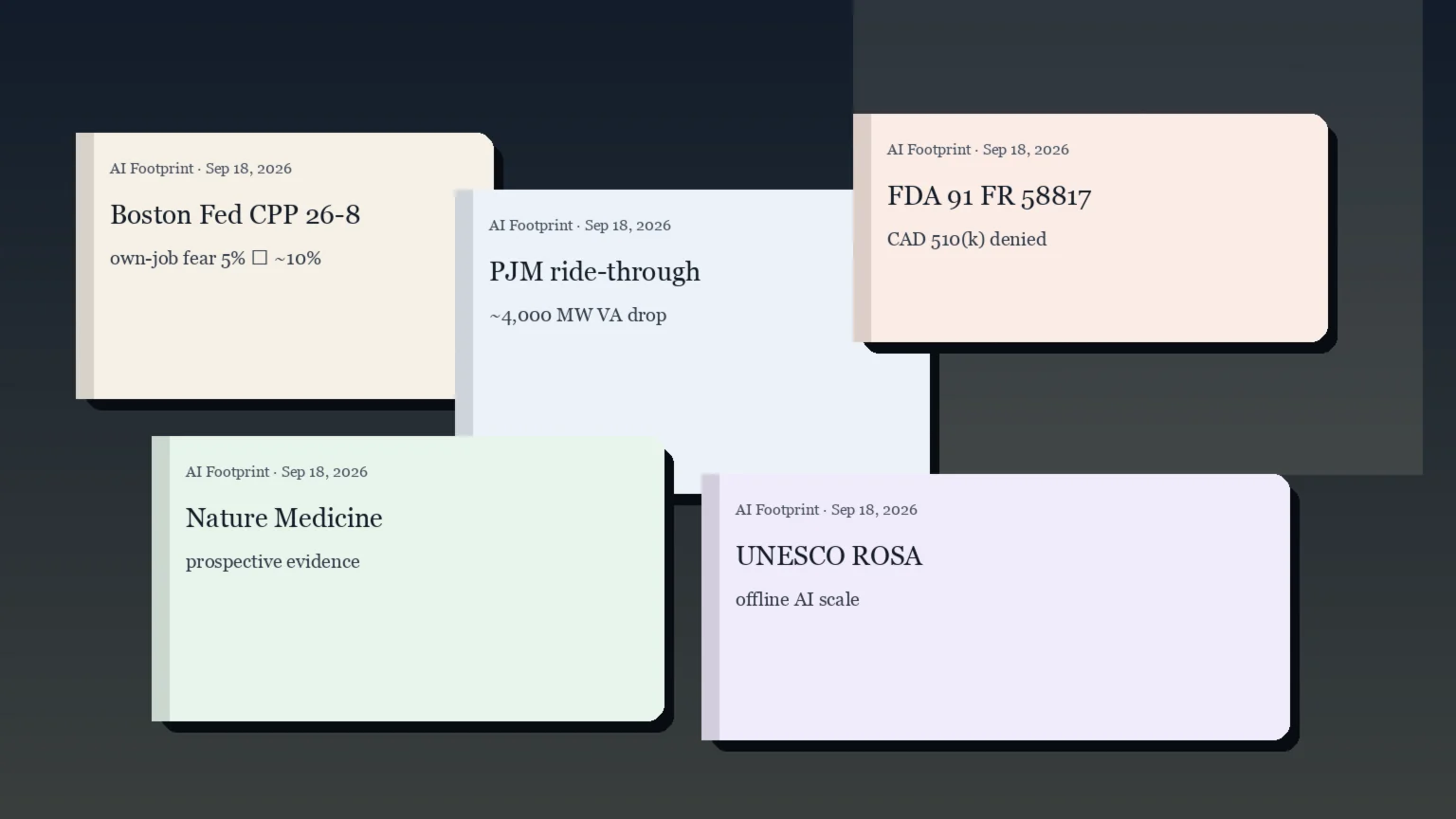
Boston Fed: workers’ own-job AI-loss fear roughly doubled — while most still expect industry cuts, not their own pink slip.
What happened: The Federal Reserve Bank of Boston published Current Policy Perspectives 26-8, Workers’ Perspectives on Artificial Intelligence: Productivity Gains and Job-loss Fears, drawing on two New York Fed Survey of Consumer Expectations special modules (about 1,300 U.S. household heads in December 2024 and December 2025). From the extracted page: the share of workers concerned about losing their own job to AI nearly doubled — from 5 percent at end-2024 to just over 10 percent at end-2025. Broader negative job outcomes (job loss, lower wages, or considering alternatives while unable to adapt) rose from about 11 percent to 18 percent. Education split locked: none of the doctorate or professional-degree respondents indicated own-job concern in 2024; by 2025, more than 11 percent of professional-degree holders and 14 percent of doctorate holders did. Industry own-job concern in 2025: consumer services 23 percent, leisure 21 percent, firm services 15 percent. Gap locked: about 10 percent worried about their own job, while 60 percent expected AI-related layoffs or fewer total workers in their industry. In the three highest-concern industries, workers also expected new AI-related roles (firm services 54 percent, leisure 55 percent, consumer services 37 percent). Among the 6 percent of AI-exposed workers with the strongest perceived productivity gains, 14 percent were more likely to ask for a raise because of AI — versus roughly 1.9–6.4 percent in lower productivity bins. Authors’ synthesis on the page: workers believe AI will restructure many jobs rather than eliminate human labor on a large scale. This is a household-survey / Current Policy Perspectives result — authors’ views, not official FOMC policy, not yesterday’s Cleveland Fed WP 26-22 production-function complementarity model, not Kansas City Fed industry-contribution bulletin, not St. Louis Fed occupation-and-task adoption, not Dallas Fed Lightcast posting declines, and not a 2026 layoff census.
Why it matters: After a run of model and industry-contribution prints, the jobs beat is what workers themselves report — fear is rising, industry cuts feel more likely than personal ones, and the small group that feels big productivity gains is also the group more willing to ask for a raise.
PJM proposes ride-through rules after nearly 4,000 MW of data-center load dropped off the grid in northern Virginia.
What happened: PJM Inside Lines reported a Planning Committee proposal, announced 8 September 2026, for new interconnection reliability requirements so Large Loads — specifically computational loads including data centers and crypto-mining — stay connected during normally cleared transmission disturbances. Trigger locked from the page: on 22 July, during a northern-Virginia event in the Dominion zone, nearly 4,000 MW of data-center load unexpectedly disconnected from PJM and switched to on-site backup generation. Operators managed load-generation imbalance plus spikes in transmission voltage and system frequency. The grid did not experience “unresolvable reliability impacts that day,” but this is the third separate measurable event in two years, per David Souder of PJM System Operations. Quote locked: “This type of operation is unsustainable and needs to be addressed.” Scope locked: minimum voltage and frequency ride-through for existing and future Large Loads, with a transition plan for existing facilities. FERC clock locked: the proposal also responds to an 18 June FERC order requiring PJM to identify gaps in evaluating Large Load reliability impacts; PJM plans to file proposed solutions with FERC in November. Context on the page: follows standards advanced by MISO, ERCOT, and transmission owners including Dominion and AEP; NERC is developing Large Load reliability guidance. This is a proposed reliability standard plus event report — not yesterday’s AEMA flexibility-coalition launch, not ERCOT Batch Zero queue megawatts, not IEA Electricity 2026 Grids chapter, not LBNL’s national-lab TWh path, not DOE draft Needs Study congestion-hours print, not PJM LTLF peak-growth figures, and not a metered annual data-center TWh census.
Why it matters: After a stretch of queues, load forecasts, and voluntary flexibility coalitions, the environment beat is whether large AI loads must stay on the system through normal disturbances — ride-through design, not another 2030 electricity-share path.
FDA denies a 510(k) exemption petition for radiology CAD and triage software — effective 17 September.
What happened: The Federal Register published final order 2026-19074 (91 FR 58817), Medical Devices; Exemption From Premarket Notification: Radiology Computer-Aided Detection and/or Diagnosis Devices and Computer-Aided Triage and Notification Devices, effective 17 September 2026. Action locked: FDA denied petition docket FDA-2025-P-5560, which had sought a partial exemption from 510(k) premarket notification for, when petition conditions were met, radiological computer-assisted diagnostic software for lesions suspicious of cancer; medical image analyzers; radiological computer-aided triage and notification software; and radiological computer-assisted detection and diagnosis software. Process locked: petition notice 29 December 2025; denial issued to the petitioner 1 April 2026; this order publishes the determination under the FD&C Act (CFR pointer 21 CFR 892). This is a petition denial published as a final order — not a new device authorization, not the FDA generative-AI medical-device discussion paper (comments still due 19 October), not NIST AI 200-2 (comments still due 6 October), not yesterday’s ISED Canada transparency consultation, and not live EU Article 50 chatbot/mark duties (day 47 calendar only).
Why it matters: The policy beat is a concrete device-gatekeeping decision — FDA kept radiology CAD and triage software on the 510(k) path rather than granting an off-ramp — separate from the still-open GenAI-device comment docket.
Nature Medicine: trust in clinical AI cannot be benchmarked into existence — prospective real-world evidence is non-negotiable.
What happened:Nature Medicine published the comment Prospective evidence for conversational medical AI is hard, but non-negotiable (Schaekermann et al.; DOI 10.1038/s41591-026-04639-5; version of record 14 September 2026). Lede locked from the page: “Trust in clinical artificial intelligence (AI) cannot be benchmarked into existence. It must be earned through rigorous prospective studies in real-world clinical settings, where the hardest lessons often concern the humans and systems around the AI, not the technology itself.” Author block includes Google Research, Google DeepMind, Beth Israel Deaconess / Harvard, Included Health, and Stanford; competing interests note Alphabet funding and possible Alphabet / Included Health equity. This is a comment / evidence-standard argument — not a prospective patient-outcome RCT, not yesterday’s Nature Paper2Agent methods paper, not the Nature Medicine on-premise clinical-agent simulation, and not I3LUNG. Standing calendar only: WHO GI-AI4H Hangzhou 16–18 September ends today with no communique locked here.
Why it matters: After a run of methods and simulation papers, the science beat is the bar for trust — prospective real-world studies, not another leaderboard score.
UNESCO ROSA Strategy Lab: scale AI and simulation learning beyond the pilot — especially where connectivity is thin.
What happened: UNESCO published Beyond the pilot: UNESCO and partners explore scaling AI and simulation learning for lasting youth impact, covering a Strategy Lab during UNESCO Digital Learning Week 2026 in Paris, organized by the UNESCO Regional Office for Southern Africa (ROSA) with Nudle. Focus locked: low-resource higher education — limited connectivity, uneven infrastructure, constrained budgets, educator readiness, and unequal access. Named vehicle: TECH SPARK Africa (Technology Empowerment and Competency Enhancement for Skills, Professional Articulation and Knowledge Innovation), with examples of simulation-supported learning, offline AI, and cross-device approaches where specialized equipment or reliable internet is limited. Core claim locked: scaling digital transformation requires more than scaling technology — infrastructure and connectivity plus educator capacity, curriculum alignment, accessibility, institutional ownership, and long-term sustainability. Youth-centered line on the page: value is whether it improves learning and expands opportunities, not the sophistication of the stack. This is a Strategy Lab / implementation-conditions piece — not yesterday’s World Bank Europe and Central Asia skills-divide blog, not UNICEF Education Strategy 2026, not UNESCO AI4EAC, not Ghana TVET scale-up, and not a multi-country learning-outcomes RCT. No independent dateline is locked on the extracted page; Digital Learning Week itself ended 11 September.
Why it matters: The education beat is whether AI and simulation can work offline and at scale in low-resource higher education — implementation conditions, not another connected-campus pilot announcement.
What happened: Keep Boston Fed CPP 26-8 as SCE household perceptions: own-job fear 5% → just over 10%; broader negative outcomes ~11% → 18%; 60% industry disruption vs 10% own-job; doctorate 14% / professional >11% own-job concern in 2025; strongest-gains bin 6% of sample with 14% likelier to ask for a raise. Keep separate from Cleveland Fed WP 26-22 complementarity and from Kansas City / St. Louis / Dallas prints.
Why it matters: Surveyed fear and industry expectations are a different evidence class than production-function models or firm posting declines.
What happened: Keep PJM as proposed Large Load ride-through after the ~4,000 MW northern-Virginia disconnection; third event in two years; data centers and crypto; FERC file planned for November. Keep separate from AEMA coalition launch, ERCOT Batch Zero queue, IEA Grids, LBNL TWh paths, and PJM LTLF peak growth.
Why it matters: Grid policy for AI load now includes forced stay-connected design — not only voluntary flexibility standards or national electricity-share forecasts.
A 510(k) denial is not the GenAI discussion paper.
What happened: Keep FDA 91 FR 58817 as a denied radiology CAD/CADt 510(k) exemption petition, effective 17 September 2026. Day-47 Article 50, NIST AI 200-2 still due 6 October, FDA GenAI-device comments still due 19 October, FTC personalized pricing still due 25 September, and Canada ISED still open through 23 September remain standing calendar only.
An evidence-standard comment is not a bedside trial.
What happened: Keep Nature Medicine 04639-5 as the prospective-evidence bar for conversational medical AI. Standing clock only: WHO GI-AI4H Hangzhou ends today as calendar context.
Why it matters: Trust claims need real-world prospective studies — not claimed patient-outcome gains from a comment alone.
What happened: Keep UNESCO ROSA / TECH SPARK Africa as beyond-pilot implementation conditions for simulation and offline AI in low-resource higher education. Standing context only: Digital Learning Week ended 11 September; UNESCO consultation comments due 15 October.
Why it matters: Low-resource scale design is the beat — measured multi-country learning gains remain unclaimed.
Planning Committee proposal (8 September): Large Loads including data centers and crypto must ride through normally cleared disturbances; FERC filing planned for November.
Proposed reliability requirements — not AEMA coalition launch; not PJM LTLF peak growth.
Day-47 EU Article 50 calendar only; Canada ISED closes 23 September; FTC personalized pricing still due 25 September; NIST AI 200-2 still due 6 October; FDA GenAI-device comments still due 19 October; WHO GI-AI4H Hangzhou ends today.