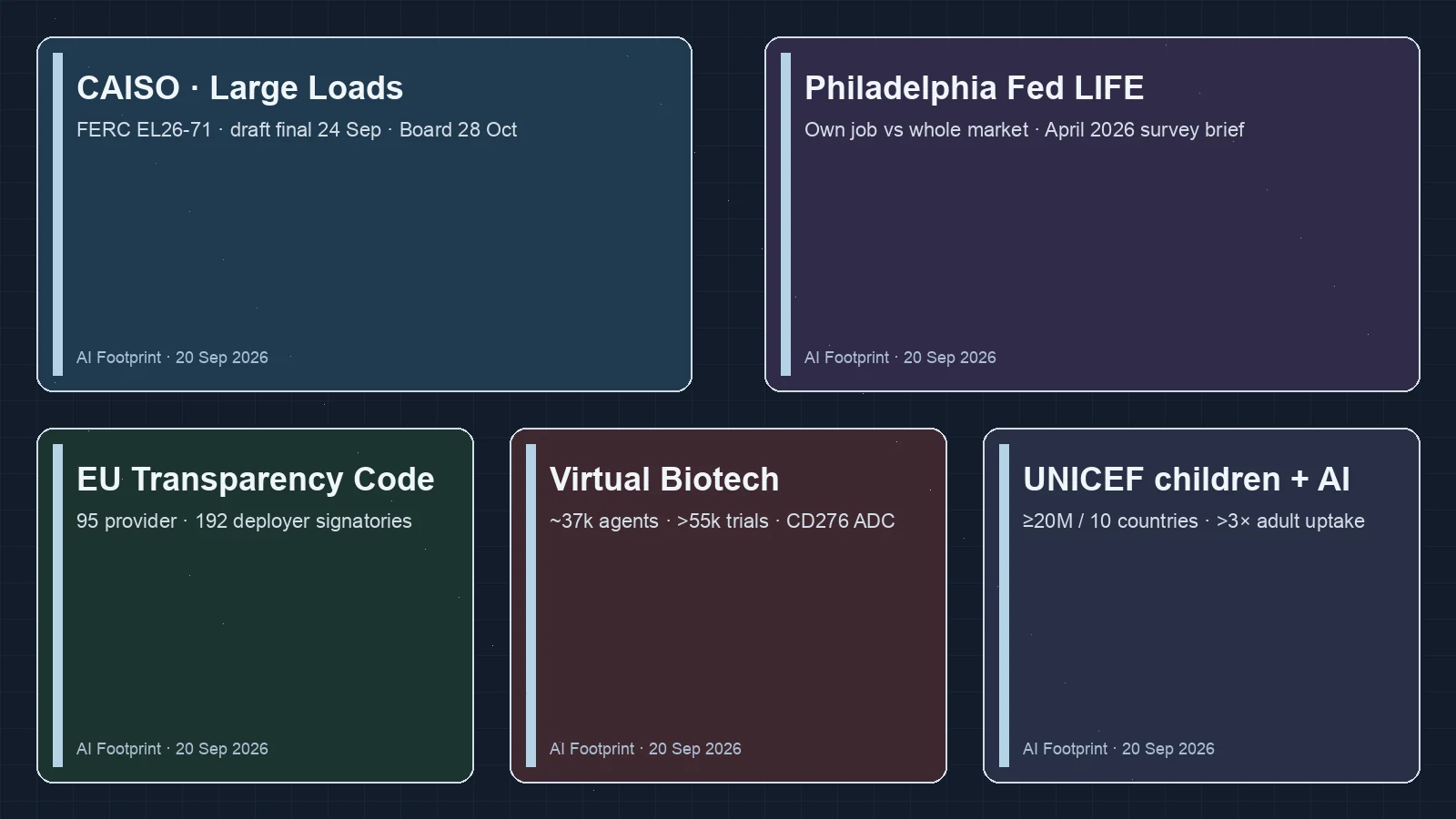
CAISO’s Large Loads clock: FERC’s June show-cause forces a West-coast tariff answer — draft final and draft tariff language due 24 September.
What happened: The California Independent System Operator’s Stakeholder Center page for the Large loads initiative frames the problem as growth in data centers, advanced manufacturing, and other large energy users putting pressure on how big loads connect to and are served by the transmission system. Process status on the page: Proposal Development, launched 27 February 2026. The page locks a June 2026 FERC Order to Show Cause (filename EL26-71-000) directing CAISO and other regional grid operators to test whether existing tariffs, interconnection processes, transmission services, and cost allocation remain just and reasonable for these load types — with aims to integrate large loads reliably, prevent cost shifting to other customers, and keep transparency on system impacts. Near-term calendar locked on the page: straw-proposal comments were due 2 September 2026; 24 September 2026 is the draft final proposal and draft tariff language posting; hybrid meeting on the draft final 1 October; comments on draft final plus draft tariff 15 October; meeting on draft tariff language 19 October; Board of Governors meeting 28 October 2026. The initiative is the forum for CAISO’s response, its 205 filing, and longer-term large-load integration and demand flexibility. This is a stakeholder tariff-response clock — not a delivered megawatt or terawatt-hour census on the page, not yesterday’s IEA observed-2025 data-centre electricity growth and offtake recap, not PJM’s ride-through proposal after nearly 4,000 MW of northern-Virginia disconnection, not ERCOT Batch Zero queue megawatts, not IEA Electricity 2026 Grids stalled-queue totals, and not LBNL’s national-lab TWh share.
Why it matters: After ride-through design, queue audits, and 2025 growth-rate prints, the environment beat is how one major ISO turns a FERC show-cause into tariff language — cost shifts and interconnection rules, not another TWh path.
Philadelphia Fed LIFE: workers reject AI damage to their own job — and still say the whole market is changing.
What happened: The Federal Reserve Bank of Philadelphia’s Consumer Finance Institute published Tom Akana’s brief It’s You, Not Me – Survey Data on AI’s Impact on Employees (April 2026), drawing on the LIFE Survey. From the HTML only: generally and across most demographic groups, employed respondents are very likely to disagree that AI is directly affecting their jobs or career opportunities, and very likely to agree that AI is affecting the job market as a whole. The page frames mixed effects “on employees and on the job market.” No layoff census, vacancy headcount, or independently extracted percents appear on the HTML used here. This is a LIFE Survey employee-perception brief — author’s views, not FOMC policy, not Minneapolis Fed Freund–Mann within-occupation task-cluster modeling, not Boston Fed CPP 26-8 household fear survey with its own-job vs industry percents, not Cleveland Fed WP 26-22 complementarity, not Kansas City Fed industry-contribution bulletin, not St. Louis Fed occupation-and-task adoption, not Dallas Fed Lightcast posting declines, and not a restamp of New York Fed firm-adoption shares.
Why it matters: After task-transformation models and fear surveys, the jobs beat is the own-job / whole-market split from a different Reserve Bank’s consumer-finance survey — perception asymmetry without a pink-slip count.
EU Transparency Code of Practice: 95 provider and 192 deployer signatories — voluntary marking/labelling help beside day-49 Article 50 duties.
What happened: The European Commission’s Digital Strategy news page reports strong backing for the Code of Practice on Transparency of AI-generated Content, with the parallel policy page detailing the instrument. From the pages: a voluntary code drafted by independent experts and assessed as adequate by the Commission and the AI Board, detailing measures to help providers and deployers of generative AI systems comply with legal obligations to mark and label AI-generated content. It complements, and does not replace, the AI Act or the Commission’s Article 50 guidelines. Structure: Section 1 covers providers — machine-readable marking and detection of AI-generated or manipulated outputs (audio, image, video, text). Section 2 covers deployers — labelling of deepfakes and of AI-generated or manipulated text publications on matters of public interest, unless human review plus editorial responsibility applies; EU icons for labelling are offered as an option. Signatory layer: by end of July 2026, about 190 organisations had signed ahead of marking obligations on 2 August 2026; about half of those early signatories were small and recent companies. Live list fetched for this edition: Section 1 signatories: 95; Section 2 signatories: 192. Named Section 1 examples include Aleph Alpha, Anthropic, Black Forest Labs, Cohere, Google, Meta, Microsoft, Mistral, OpenAI, and Synthesia. The code remains open for signature. Clock: signatories are invited to collaborate in two task forces to be launched in September 2026 on best practices, implementation feedback, and advancing marking and labelling. This is a voluntary code plus live signatory list — not a restatement of Article 50’s legal text (day 49 of live enforcement, calendar only), not the GPAI Code of Practice Articles 53/55 track, not yesterday’s NIST NVD agent webinar, and not a new statute.
Why it matters: The policy beat is industry uptake of marking and labelling practice while Article 50 duties run — a different instrument from GPAI safety/copyright codes and from U.S. vulnerability-database modernization.
Nature on Virtual Biotech: as many as 37,000 AI agents mined more than 55,000 trials and proposed a CD276 lung-cancer ADC — still unvalidated in the lab.
What happened: Nature news recapped Zou, Zhang, and colleagues’ Science paper on “Virtual Biotech,” a multi-agent system for drug discovery. From the Nature page only: the system comprises as many as 37,000 agents (the page also notes a CSO assigning 37,075 agents, each tackling a single later-stage trial). Agents analysed published results of more than 55,000 clinical trials. A CSO agent directs “employees” across divisions such as target identification and clinical-trial design; versions of Claude were used as the underlying LLM in the study, with the claim that other advanced LLMs, including open-source models, could substitute. Predictor locked from the same page: drugs targeting proteins active in specific cell types were nearly 50% likelier to reach market than other drugs, from the agents’ search for success predictors in gene-activity data. Case locked: directed to investigate CD276 as a lung-cancer target, the system confirmed the candidate on previously collected data and proposed a CD276-recognizing antibody tethered to an anticancer drug (an ADC); external reviewers, with the authors, called it a promising avenue. Limit locked from the same page: the approach is not vetted in real-world drug discovery; predictions were not validated through experiments, let alone clinical trials. This is secondary journalism of an in-silico multi-agent methods paper — not a bedside patient-outcome RCT, not yesterday’s JMIR first-trimester antenatal risk model across more than half a million pregnancies, and not a Nature Medicine prospective-evidence comment.
Why it matters: After clinical risk tools and evidence-standard comments, the science beat is agent-swarm literature mining for discovery hypotheses — with an explicit non-validation caveat still on the page.
UNICEF: at least 20 million children across 10 countries have used AI — more than three times faster uptake than adults, with deepfake and scam fears already live.
What happened: UNICEF’s press release Children are adopting AI technologies more than three times faster than adults (30 June 2026, New York / Florence) reports analysis drawing on new data from 10 countries estimating that at least 20 million children have used AI, with many outpacing adults by adopting it at rates more than three times faster. Use locked from the release: more than 2 million children — 1 in 10 — said they turn to AI for advice on things that worry them; an estimated 13 million said they use it to support learning and homework. Risk locked: in the 10 countries, a third of children reported concerns about AI used to scam or trick others or spread misinformation; a quarter feared images or videos manipulated into sexually explicit deepfakes. Attributed UNICEF commentary on the page: a generation is growing up inside a “global experiment,” and most AI governance “does not prioritise children.” Method notes: Disrupting Harm Phase 2 (UNICEF Innocenti, ECPAT International, INTERPOL; Safe Online funding). Countries named: Armenia, Brazil, Colombia, Dominican Republic, Jordan, Mexico, Montenegro, North Macedonia, Pakistan, Serbia. About 1,000 internet-using children aged 12–17 and 1,000 parents or caregivers per country; sampling aimed at 91–100% national coverage; national point estimates weighted by UN 2024 population data and estimated child internet-use rates. This is a child-uptake and protection snapshot dated 30 June 2026 — not a PISA learning-outcomes print, not yesterday’s World Bank The Job I Hope For adult intro-AI campaign for Sub-Saharan Africa, not UNESCO ROSA / TECH SPARK, and not UNICEF Education Strategy 2026 as a restated lead.
Why it matters: The education beat is children’s actual AI use and protection gaps — scale and risk in 12–17 internet users, not another adult skills campaign or connected-campus pilot.
What happened: Keep CAISO Large Loads as FERC show-cause EL26-71 (June 2026); draft final proposal and draft tariff language 24 September 2026; Board of Governors 28 October 2026; reliability, cost-shift prevention, and transparency aims. No independently extracted MW, GW, or TWh census on the stakeholder HTML. Keep separate from IEA observed-2025 +17% / five-firm capex / SMR offtake, PJM ride-through ~4,000 MW, ERCOT Batch Zero, IEA Grids queue totals, and LBNL share.
Why it matters: Process and cost-allocation design is a different evidence class than metered growth rates or single-event disconnection reports.
What happened: Keep Philadelphia Fed LIFE as the perception split: employed respondents disagree that AI is hitting their own job or career opportunities and agree that AI is hitting the job market as a whole, across most demographic groups. No percents locked beyond that HTML claim. Keep separate from Minneapolis Fed Freund–Mann task clusters, Boston Fed CPP 26-8 fear percents, and other Reserve Bank adoption or posting prints.
Why it matters: Survey perception asymmetry is a different evidence class than model-based wage paths or firm layoff microdata.
A voluntary marking code is not Article 50 itself.
What happened: Keep the EU Transparency Code of Practice as live 95 Section 1 and 192 Section 2 signatories; task forces launching in September 2026; marking obligations from 2 August 2026. Day-49 Article 50 remains calendar only. Standing clocks only: Canada ISED still open through 23 September; FTC personalized pricing and NIST SP 800-239 still due 25 September; NIST AI 200-2 still due 6 October; NVD modernization RFI still due 13 October; UNESCO consultation still due 15 October; FDA GenAI-device comments still due 19 October.
What happened: Keep Virtual Biotech as Nature’s recap of the Science multi-agent system — ~37,000 / 37,075 agents; more than 55,000 trials analysed; cell-type-specific targets nearly 50% likelier to reach market; CD276 ADC proposal; predictions not experimentally validated. Standing clock only: WHO GI-AI4H Hangzhou ended 18 September with no communique locked here.
Why it matters: In-silico discovery hypotheses need lab and clinical follow-through — the Nature page is explicit that those steps have not happened.
What happened: Keep UNICEF’s 30 June snapshot as ≥20 million children / 10 countries; more than 3× adult uptake; 2 million / 1 in 10 advice; 13 million homework; one-third scam-misinfo concern; one-quarter sexual-deepfake fear; ~1,000 children 12–17 plus ~1,000 caregivers per country. Standing context only: UNESCO consultation comments due 15 October.
Why it matters: Protection and governance for children already inside the AI experiment is the beat — not registrant headcounts for adult skills campaigns.
The full daily ledger keeps broader source-linked coverage organized by topic. Story dates are shown separately from the September 20 edition date.
September 20 · CAISO Large Loads
CAISO stakeholder initiative: FERC June 2026 show-cause EL26-71 on tariffs, interconnection, transmission service, and cost allocation for data centers and other large loads; draft final proposal and draft tariff language posting 24 September 2026; Board 28 October.
Tariff-response clock — not IEA +17% 2025; not PJM ride-through; no MW census on the page.
Initiative aims locked on the page: integrate large loads reliably, prevent cost shifting to other customers, keep transparency on system impacts; status Proposal Development since 27 February 2026.
Process design — not ERCOT Batch Zero; not LBNL TWh share.
Philadelphia Fed LIFE Survey brief (April 2026): employed respondents very likely to disagree AI is affecting their own job/career and very likely to agree AI is affecting the job market as a whole.
Perception brief — not Minneapolis Fed Freund–Mann; not Boston Fed CPP 26-8 percents.
EU Code of Practice on Transparency of AI-generated Content: live list Section 1 providers 95; Section 2 deployers 192; ~190 had signed by end-July ahead of 2 August marking obligations.
Voluntary code uptake — not GPAI Code 53/55; not a restated Article 50 FAQ.
Signatories invited to two task forces launching in September 2026 on best practices, implementation feedback, and advancing marking/labelling; code remains open.
Implementation forum — not NIST NVD agent webinar; not FDA 510(k) denial.
Nature recap of Science Virtual Biotech: as many as 37,000 / 37,075 agents; more than 55,000 clinical trials analysed; cell-type-specific targets nearly 50% likelier to reach market.
In-silico agent swarm — not JMIR first-trimester ML; not a bedside RCT.
System proposed a CD276-recognizing antibody-drug conjugate for lung cancer; Nature page states predictions were not validated through experiments or clinical trials.
Hypothesis generation — not experimental proof; not Nature Medicine evidence comment.
UNICEF (30 June 2026): at least 20 million children across 10 countries have used AI; uptake more than three times faster than adults; 13 million homework support; 2 million / 1 in 10 advice.
Child snapshot — not World Bank Job I Hope For; not UNESCO ROSA.
In the 10 countries, a third of children worried about scam/misinfo uses; a quarter feared sexually explicit deepfakes; ~1,000 children 12–17 and ~1,000 caregivers surveyed per country.
Protection gap — not PISA; not an adult intro-AI campaign.
Day-49 EU Article 50 calendar only; Canada ISED closes 23 September; FTC personalized pricing and NIST SP 800-239 still due 25 September; NIST AI 200-2 still due 6 October; NVD RFI still due 13 October; UNESCO consultation still due 15 October; FDA GenAI-device comments still due 19 October; CAISO Board 28 October.